Dental Implants Vs Dentures: What’s Right For Your Smile?


Compare Dental Implants options before you commit
Get clinic options, pricing guidance, and recovery expectations from Envoy Health before taking the next step.

Table of contents
- The Tooth Loss Problem
- Are Dental Implants the Same as Dentures?
- Dental Implants vs Dentures: Key Differences
- Dental Implants vs Dentures: Pros and Cons
- Dental Implants vs Dentures: Which Is Better?
- When Dentures May Be the Better Option
- Will Dental Implants Ever Be Affordable?
- Dental Implants vs Dentures: Which Is Right for You?
Key Takeaways
- Dentures and dental implants are two types of tooth-replacement options that serve the same purpose but work differently. Dentures are removable, affordable devices and involve a non-invasive procedure. Dental implants are a permanent option involving an invasive procedure.
- Dentures are suitable for people with insufficient jawbone and those seeking a less expensive option. Setting realistic expectations is crucial, as the procedure requires specialized maintenance and cleaning routines.
- Dental implants are ideal for those looking for a long-term, stable solution. Having adequate jawbone and being free from habits like smoking and chronic illnesses ensures the success of the treatment. This long-term investment is more expensive than other tooth-replacement options.
Still comparing Dental Implants options?
Envoy can help you compare reviewed clinics, pricing guidance, and recovery expectations before you make a decision.
Tooth Loss Problem
Tooth loss is about more than missing teeth and awkward gaps. It's losing function and failing to perform routine activities, such as chewing food and talking clearly. The fallen teeth make chewing and grinding difficult, making it uncomfortable to enjoy favorite foods. Gaps left by missing teeth allow air to flow out, disrupting speech clarity. Looking more closely, these actually set you apart from social settings and public gatherings, undermining your self-esteem and creating a sense of self-consciousness. It's natural for people to seek better tooth replacement options that restore function and appearance. Thanks to modern dentistry and variety of tooth replacement options are available in today's market. Among other options, dentures and dental implants are two leading choices, each with its own benefits and considerations.
Are Dental Implants the Same As Dentures?
No, dental implants are not the same as dentures. Both replace missing teeth and serve common functions, including chewing, speaking clearly, supporting facial muscles, and improving aesthetics. However, these differ primarily in their design, stability, cost, and durability.
Dental implants are permanent and are anchored surgically within the jawbone. These come as tiny screw-like devices that your dentist will place in the jawbone. Over time, these fuse with the surrounding jawbone, forming a strong bond and mimicking the natural tooth roots. Dentures, on the other hand, are mostly removable prostheses that are fixed to the gums. Dentures may be partial or complete for a jaw, and appear as an artificial tooth line borne on pink colored gum base. These are an affordable, convenient solution that avoids tedious procedures.
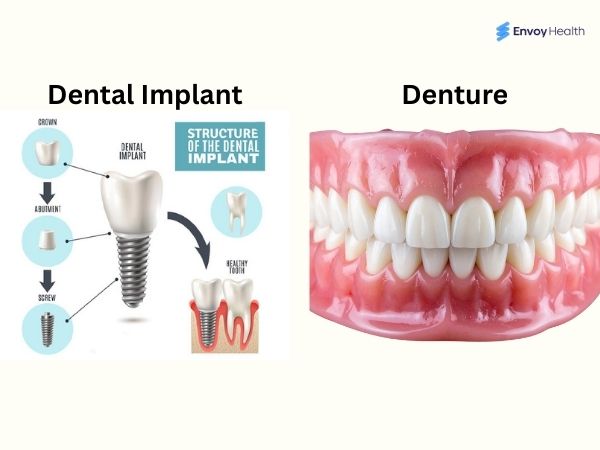
Understanding the Difference Between Dental Implants and Dentures
Dentures and dental implants differ significantly in materials, procedures, costs, maintenance, and lifespans. Understanding each option in detail can help you make a well-informed choice specific to your requirements and expectations.
Dental Implants vs. Dentures: Composition and Design
Dentures are made from high-quality pink-colored acrylic bases that mimic the natural gums. This device features artificial teeth that restore lost chewing and biting abilities and improve mastication. These may be partial or complete, depending on the number of missing teeth. Depending on the oral health condition and number of missing teeth, dentures may include metal clasps or snap-in locators to ensure a snug fit on the gums. Dental implants, on the other hand, are small titanium screws. These are fixed in the jawbone and have artificial teeth on top. Dentists secure crowns or dentures to implants with metal screws called abutments. These artificial teeth are in place while implants stay embedded within the jaw. The number of implants you need depends on how many teeth are missing. Each implant replaces one missing tooth root. However, when you are left with a completely edentulous jaw, you will need 4,6 or 8 dental implants to support an entire set of artificial teeth.
Dental Implants vs. Dentures: Procedure, Treatment Timeline, and Recovery
While both implants and dentures involve a step-by-step procedure with multiple dental visits, implants require surgery. Dentists cut open the gums to position the implants and close the incisions with sutures. The gums require 6-12 months to completely heal, after which the permanent prostheses are fixed. The complete process may take up to 1 year, or longer in some cases (when additional procedures are required). Recovery after dental implants is quite tedious. You should follow strict dietary measures and specific lifestyle routines to ensure success. You will rely on a soft diet, avoid strenuous activities, and use pain medication for a few days.[1] Dentures, on the other hand, do not involve invasive methods. Your dentist will collect tooth impressions and send them to the dental lab for denture fabrication. The custom-fabricated dentures provide a precise fit, and the dentist will secure them to the gums where natural teeth are missing. They are fixed using snap-in locators and metal clasps. The entire denture process will take a few days, and recovery is straightforward. Unlike implants, denture recovery does not require strict dietary restrictions. However, the cleaning and maintenance procedures follow a predefined protocol. You should remove your dentures during night and soak them in a cleaning solution. This will prevent denture stomatitis and ensure the long-term success of dentures.
Dental Implants vs Dentures Complications
Because tooth implants and dentures differ in treatment procedures, their complications and negative effects also vary considerably. Dental implants, being a surgical procedure, carry surgical risks such as infection, nerve damage, poor healing, and peri-implantitis. These are serious and may lead to jawbone loss and require additional procedures or implant removal. On the other hand, dentures, being a non-surgical procedure, do not pose serious risks. You don’t have to bother about healing. However, dentures gradually lose their snug fit. Additionally, improper maintenance and poor oral hygiene can damage gum tissue and cause stomatitis.[2] These consequences may not be life-threatening in most cases; however, require prompt care for better results.
Dental Implants vs Dentures Cost
Dental implants and dentures vary considerably in their costs. The cost of implants is higher than that of dentures. On average, dental implants cost between $5,000 and $40,000, depending on the number of implants and the type of prosthesis. These high prices largely reflect the cost of the associated surgical procedure, the use of expensive materials, and advanced technology. Dentures, on the other hand, are customized prostheses that do not require invasive surgical procedures. Their price range is $4,000 to $10,000, depending on material quality and the number of missing teeth. Denture costs are slightly lower than those of dental implants because the procedure uses simpler materials and less complex laboratory work.
Dental Implants vs False Teeth Function
Dental implants and dentures primarily restore essential oral functions, such as chewing, speaking clearly, and maintaining facial structure. However, the key difference is that dental implants integrate with the jawbone, forming a lasting connection. They mimic the natural roots and work as an active stimulus to prevent jawbone loss. Dentures, on the other hand, serve solely as prosthesis devices. They do not form any tissue connection with the oral parts. For this reason, dentures typically require replacement every 7 to 10 years. This is unlike dental implants, which last a lifetime.
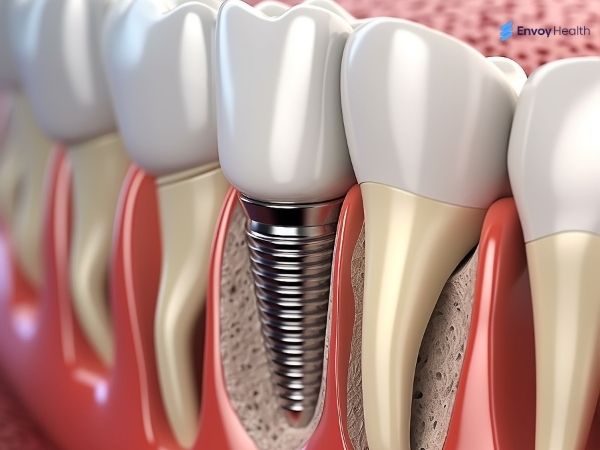
Understand the Dental Implants vs Dentures Pros and Cons
Every healthcare decision has pros and cons. Understanding and weighing them against your personal goals will help you make the best decision. Below, we outline the pros and cons of dental implants and dentures to help you make a clear, informed decision.
|
Pros of Dental Implants and Dentures |
|
|
Dental Implants |
Dentures |
|
Long-lasting, lasts for a lifetime |
Relatively lower upfront costs |
|
Natural looking and simpler maintenance (same like natural teeth) |
Natural looking |
|
Restores chewing, speaking clearly, and imparts a better facial structure |
Restores chewing, speaking clearly, and prevents sunken cheeks |
|
Preserves jawbone, prevents adjacent teeth from drifting, and improves oral health |
No surgical procedure and recovery is simple |
|
Cons of Dental Implants and Dentures |
|
|
Dental Implants |
Dentures |
|
Expensive upfront costs |
Poses difficulty during the initial acclimation period |
|
Involves a surgical procedure |
Requires periodic replacement and maintenance procedures for longevity |
|
Longer healing time with the risk of complications such as infection and nerve damage |
Cannot stop jawbone resorption, potentially causing sunken cheeks and facial changes over the years |
|
Strict candidature requiring an adequate jawbone, being free from bone and chronic health issues |
Require special nightly cleaning routines, which may involve additional costs for cleaning kits and solutions. |
Dental Implants vs Dentures Which Is Better?
The answer to this depends on your expectation from tooth replacement. It's important to note that dentures and dental implants are umbrella terms that encompass a variety of options. The type of dental implants or dentures you choose depends on the number of missing teeth, your oral health and jawbone condition, lifestyle, and budget. While implants are an invasive procedure, dentists offer a range of denture options, which can be confusing. Additionally, some dentures include dental implants in the jaw. This overlap often makes it harder to draw a simple line between them. Here, we provide an in-depth analysis of the common choices that often cause confusion.
Dental Implants vs Snap in Dentures
Snap-in dentures, also called the implant-retained overdentures, differ from traditional dentures. These come with 2 or 4 implants per jaw, with the denture secured using the snap-in locator. Snap-in dentures are an upgraded version of conventional dentures. Unlike conventional dentures, these outnumber the issues, such as slippage.
Now, coming to the point, the comparison between dental implants and snap-in dentures primarily centers on cost. While both procedures involve invasive surgery, the recovery and dietary restrictions are similar. However, dental implant costs are higher than those of snap-in dentures. Snap-on dentures may be a good option if you are looking for an affordable, easy-to-clean, easy-to-handle choice.
Dental Implants vs Permanent Dentures
Dental implants and permanent dentures function similarly: both are fixed solutions that provide long-term stability and durability. They are built to last for many years and offer a secure alternative to removable prostheses. However, their typical use differs. Dental implants are often recommended to replace one or a few missing teeth, with each implant supporting an individual crown or bridge. Permanent dentures, on the other hand, are generally preferred for patients with multiple missing teeth or complete tooth loss, as they replace an entire arch using several strategically placed implants for support. The right option depends on the severity of tooth loss, jawbone health, and long-term treatment goals.
Dental Implants vs Partial Dentures
Partial dentures are a non-invasive option for 3-4 missing teeth in a jaw. These are made from acrylics, metal, and flexible materials depending on the candidate's requirements. Dentists use metal clasps or dental adhesives to fix them. Dental implants, on the other hand, are invasive procedures. These come with high-quality titanium screws, metal abutment screws, and dental crowns or complete dentures (depending on the number of missing teeth).
Dental implants can be a strong choice for those looking for a long-term solution. Partial dentures are ideal if you have a budget constraint and are comfortable with temporary solutions.
Dental Implants vs Implant Supported Dentures
Implant dentures rely on implants for stability and support, which can make choosing confusing. However, both dental implants vs implant dentures vary in the treatment procedure. The key difference is that implant dentures are used to replace many missing teeth or an entire jaw. Additionally, these are removable dentures and include snap-in locators. Dental implants, on the other hand, are non-removable prostheses. Additionally, the costs also vary considerably.
Dental Implants vs Full Dentures
Full or complete dentures are removable prostheses. These come with a pink base holding artificial teeth. While dental implants are metal screws that mimic natural tooth roots and preserve jawbone health, full dentures do not support jawbone health. In most cases, these are a temporary solution that lose fit over time. Yes! Complete dentures can become loose and no longer fit snugly as the jawbone changes over time. You will need maintenance procedures such as denture readjustment and relining to ensure a better fit.
Dental implants may be a good option if cost is not a concern and you are seeking a durable, long-lasting solution. However, full dentures are ideal when you lack sufficient jawbone to support implants and are comfortable with the costs of maintenance procedures.
Benefits of Dentures Over Implants
Below are the positives of dentures over implants:
- Simple procedure and does not require an invasive method.
- Relatively shorter treatment timeline and a minimal healing period.
- Affordable compared to implants
- Better alternative for candidates with a thin jawbone
Will Dental Implants Ever Be Affordable?
The major disadvantage many cite with dental implants is the high cost. Because the procedure involves advanced surgical techniques and medical-grade materials, the overall treatment often comes with higher price tags. Insurance can be a better way to afford dental implants. Many insurance plans partially cover implant treatment costs in medically necessary cases. This can significantly reduce costs. However, check with your insurance provider in advance for effective planning.
Dental Implants vs Dentures: Which Is Right for You?
There is no single gold-standard solution to any problem in healthcare. A better solution isn’t just about the procedure; it's also about how well it fits into your daily life. While making a choice between dental implants or dentures can be tough, you should consider a variety of factors for a better decision. Weighing the options and measuring the pros and cons specific to your case will help you make a confident choice.
- Oral and overall health: Dental implants require a strict candidature. Patients with inadequate jawbone, chronic health problems, or bone diseases cannot support dental implant treatment. In any of these conditions, dentures can be an ideal solution.
- Lifestyle and habits: Habits like smoking and tobacco consumption delay the healing after any dental procedures. Dentists suggest quitting smoking for those looking for dental implant treatment. However, implants are ideal if your diet contains many hard, crunchy, and chewy foods. Moreover, these can be a better option when you travel frequently or have a super busy routine. Although dentures withstand strong chewing forces, implants are more durable. More importantly, dentures require you to remove them at night and follow a cleaning routine, which can be cumbersome for busy lifestyles. Cleaning protocols for dental implants are much like caring for your natural teeth. This does not require a special cleaning routine.
- Treatment and maintenance timeline: Dental implants typically involve a longer treatment process, as they require surgical placement followed by a healing period that can take several months for the implant to integrate with the jawbone. Dentures, in contrast, usually have a shorter treatment timeline and minimal healing time since they do not involve surgery. However, maintenance varies over time: implants require consistent oral hygiene, similar to natural teeth, while dentures require daily removal, cleaning, and occasional adjustments or replacements.
- Cost for procedure and maintenance: Dental implants generally have a higher upfront cost due to surgery, advanced materials, and multiple appointments. However, they may require fewer replacements over time. Dentures are more affordable initially, but ongoing expenses such as relining, repairs, adhesives, and eventual replacement should also be considered when evaluating long-term costs.
Final Word!
When weighing dental implants vs dentures, there is no one-size-fits-all answer. Both options effectively restore missing teeth, but they differ in cost, procedure, comfort, longevity, and maintenance. Dental implants offer greater stability and long-term durability, while dentures provide a more affordable and non-surgical alternative. The right choice ultimately depends on your oral health, jawbone condition, lifestyle, and budget. Consulting a qualified dental professional can help you determine which solution better aligns with your needs and long-term goals.
Ready to restore your smile with confidence? Sign up with Envoy Health and connect with trusted dental specialists, tailored treatment plans, and hassle-free coordination every step of the way.
References
Ready to compare Dental Implants options?
Get clinic options, pricing guidance, and recovery expectations from Envoy Health before taking the next step.
Disclaimer
The information in this article is for educational purposes only and does not replace medical advice. Always consult your doctor before starting any treatments.
Published by Envoy Health. Reviewed for patient-safety framing by Envoy Health Medical Content Review. See our editorial, AI-assistance, and medical review policy.
To request a correction, email contact@envoyhealth.io with the page URL and supporting source.
Compare reviewed clinics, pricing guidance, and recovery expectations before you commit.
Dental implants are placed by a qualified dentist who received specialized training in performing oral and maxillofacial surgery, periodontists, and implantologists. Oral and maxillofacial surgeons receive formal education and hands-on training in performing gum and jawbone-related surgical procedures. Periodontists specialize in gum and jawbone problems. Implantologists receive advanced formal training on the surgical placement of dental implants, their restoration, and long-term maintenance. Orthodontists do not perform these procedures, as they primarily address gum and jaw alignment issues and tooth irregularities.
The best choice between tooth implants and dentures depends primarily on the case. Dentures may be a better option if you are seeking a temporary, non-invasive solution at a low cost and are comfortable with maintenance procedures. However, dental implants are ideal if you are looking for a more natural, long-lasting, and durable option.
The major downside of getting dental implants is that they are an invasive surgical procedure, with multiple dental visits over 6-12 months. Additionally, dental implants use advanced materials and rely on sophisticated technology, making them a costly procedure. Not just that, dental implants require a strict candidature for treatment success. Not everyone with fallen teeth is eligible for dental implants. Patients who smoke or have a thin jawbone, those suffering from chronic health problems, and bone diseases are not eligible for the procedure.
A dentist may not recommend dental implants when you suffered significant jawbone loss and suffer from uncontrolled health conditions such as diabetes or active bone diseases. A weak jawbone cannot support dental implants, and the procedure could lead to implant failure.
Yes, dental implants look more natural compared to dentures. The implant body, embedded in the jawbone, mimics the tooth roots and holds the artificial teeth in place. Prostheses, whether dental crowns or dentures, serve as artificial teeth, restoring function and seamlessly blending with the surrounding teeth.
So, we partner with the premier healthcare facilities!







Send me the list