Are Dental Implants Safe? A Straightforward Look at the Facts


Compare Dental Implants options before you commit
Get clinic options, pricing guidance, and recovery expectations from Envoy Health before taking the next step.

Key Takeaways
- Dental implants are fixed within the jawbone to remain inside the jaw for a lifetime. Even though these materials are widely tested and considered safe, myths and concerns about their safety are common reasons not to get dental implants.
- Tooth implant materials are safe, as they are tested for compatibility with body tissues. Being biocompatible makes them less likely to cause allergic reactions and tissue inflammation.
- Dental implant treatment is safe and has minimal side effects when performed on a suitable candidate by a qualified implantologist. Temporary and minor side effects include discomfort, swelling, pain, and bleeding from the incision site that subside within a few days.
Still comparing Dental Implants options?
Envoy can help you compare reviewed clinics, pricing guidance, and recovery expectations before you make a decision.
A Brief On Dental Implants
Dental implants are tiny screws fixed within the jaw to support artificial teeth. These come with a titanium or zirconium body inserted within the jawbone. A small screw-like abutment holds the dental crown, bridge, or entire denture in place. A modern type, screwless dental implants are fixed as a one-piece unit, with a crown on top. Implants mimic the roots of missing teeth and form a stable, secure bond with the surrounding jawbone.
Dental implants are a popular choice to replace missing teeth. These blend with the surrounding teeth while offering a strong bite and filling the gaps left by missing teeth. Unlike removable alternatives, implants are placed in the jaw and designed to stay there long-term. They’re not something you take in and out. Because of this, it’s natural for patients to wonder about their safety. Let’s take a closer look at what that really means.
Are Dental Implants Safe In The Long Run?
Dental implants are a safe and effective approach to replacing missing teeth. Studies suggest that their survival rate is 92%. They have a long track record of success and last a lifetime when performed by a qualified professional on an appropriate patient. Since the implants are made of biocompatible materials, the risk of metal allergies is too low. However, a few other factors influence the success of dental implants. Below, we detail them.
Jawbone, Oral Health, And Overall Medical Condition
Dental implants are successful when performed on patients with a healthy oral cavity, free from gum disease. A sound overall medical condition is a must. Those suffering from autoimmune diseases, uncontrolled diabetes, and soft bone diseases, such as osteoporosis, are not eligible for implant treatment. These underlying medical conditions increase the risk of complications. Besides, having an adequate jawbone is important. Candidates with too scanty jawbone cannot support the upcoming implants.
Dentists Expertise
Dental implants involve a surgical procedure where small metal screws are drilled into the jawbone. While these serve as a stable foundation for new teeth, the placement isn’t random. It’s planned with precision to ensure the implant is placed at the correct depth and position, allowing it to support the prosthesis securely over time. Improper placement of dental implants by fake experts can lead to complications, such as nerve damage. Because of this level of detail, the procedure should always be performed by a trained and experienced dental implant specialist, not just any dental professional.
Adherence To Modern Technology And Sterilization Procedures
Implant positioning within the jaw should be at an appropriate depth, neither too deep nor too shallow. Qualified dental experts use 3-D imaging technology to plan implant positioning. Advanced technologies, such as CBCT, intraoral scanners, and CAD/CAM systems, facilitate guided surgery, ensuring precision and safety. Moreover, the surgical procedure should be carried out prioritizing sterility. While dental implants come in sterile packaging, appropriate handling techniques should be adopted. The drills and forceps should be free from surface contaminants. Dental clinics should be equipped with the appropriate devices for surface sterilization. The lack of appropriate steriization can lead to infections and implant failure.
Are Dental Implants Expensive?
Dental implants cost slightly more than other treatment options. Each implant costs around $6,000, with additional costs for the prosthesis. Typically, full-mouth implants cost more than single-tooth implants. The use of high-end technology and premium materials makes dental implants a costly procedure. Weighing the higher costs, durability, and safety is an important step in the decision-making process.
Who Should Not Get Dental Implants?
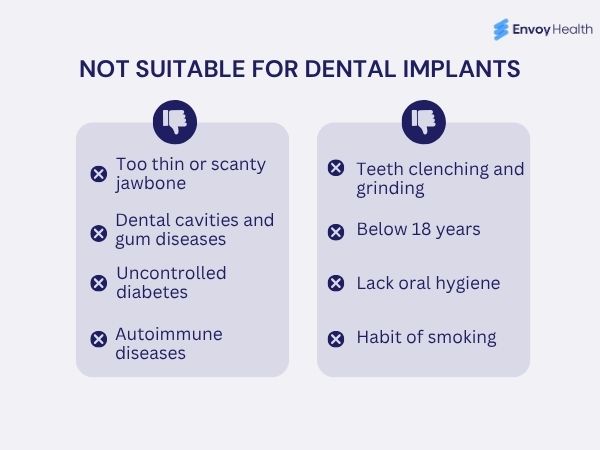
Your dentist will perform a comprehensive evaluation to confirm your candidacy. They advise alternative treatments to dental implants if you suffer from any of the following conditions.
- The jawbone is too thin or scanty to hold dental implants
- You suffer from dental cavities and active periodontal gum diseases
- You are a diabetic with uncontrolled blood sugar levels
- You suffer from autoimmune or soft bone diseases
- You are prone to parafunctional habits such as teeth clenching and grinding
- You are below 18 years of age
- You are unable to follow the basic oral hygiene measures
- You have a habit of smoking and have not quit
In this regard, we address some common questions most patients ask us.
Are Dental Implants Safe for MRI?
Getting dental implant treatment will not limit you from future MRI scans. That said, dental implants are metal posts, which can be worrying for patients. The fact is that an MRI uses a powerful magnetic field to image the patient's body. However, these do not interfere with the dental implants, because titanium and zirconium are non-ferromagnetic materials. However, having other devices, such as metal fillings, crowns, metal braces, pacemakers (in the heart), and cochlear implants, may raise safety concerns. It's better to discuss the complete medical history with the doctor before proceeding for MRI.
Are Dental Implants Safe for Diabetics?
Dental implants are safe for patients with diabetes, provided their blood sugar levels are well controlled. Studies suggest that elevated blood sugar levels slow healing and increase the risk of infection after any surgical procedure. Typically, dentists avoid implants and suggest alternative treatments for candidates with uncontrolled diabetes for this reason.
Are Dental Implants Safe For The Elderly?
Dental implants are safe for elderly individuals provided they have good overall health, adequate jawbone density, and the ability to heal. Generally, elderly candidates suffer from compromised immunity or overall health-related issues. Either of these lowers the healing rate and increases the chances of infection. Candidates with sound oral and overall health are suitable for the procedure. The success rates are similar to those of younger individuals, with age generally not being a barrier. Studies suggest that elderly individuals with higher jawbone density show better implant stability and long-term success rates.
Are Dental Implants Safe For Heart Patients?
Dental implants are generally safe for patients with heart disease when the condition is stable and well-managed. However, appropriate precautions and a cardiologist's clearance are mandatory to minimize risks.
Those who have had a recent heart surgery or suffer from uncontrolled conditions should postpone implant treatment or look for alternatives. Dentists take additional precautions, such as reviewing medications, managing bleeding risks, and planning low-stress alternative procedures. In many cases, patients are advised to temporarily adjust blood-thinning medicine to reduce bleeding and support proper healing. Note that this should be strictly under medical supervision.
Are Dental Implants Toxic?
Dental implants being toxic is a myth. They are made from safe, biocompatible materials. Medical-grade titanium and zirconium are the commonly used dental implant materials. The US FDA states these implant manufacturers follow international consensus standards laid by the International Organization for Standardization.
Dental implants are tested for biocompatibility. This is to ensure that the contact of the implant surface with human body tissues does not cause any allergic reaction or irritation. This answers the most concerning question: “Are dental implants safe for your body?” Implants are made from materials that have been tested and proven safe.
Still, some candidates might experience slight adverse reactions. While the chances of complications are rare, these occur when the procedure is performed on an inappropriate candidate or by a fake professional. Below, we detail the side effects of the inappropriate treatment.
Tooth Implant Side Effects
The common temporary side effects of dental implants are swelling, pain, bruising, and minor bleeding from the incisional site. These slowly subside with time and adherence to the aftercare measures. However, a few candidates experience severe side effects following a dental implant procedure. An important point to note is that dental implants have a higher success rate. The risk of complications is low, provided the procedure is performed on the right candidate by a qualified professional. Here we listed the tooth implant side effects:
- Nerve damage due to the implant's wrong positioning or overdrilling
- Sinus issues causing pain and congestion, when implants in the upper jaw protrude into the sinus cavities
- Implant failure when the jawbone fails to form a strong bond with the implant surface and osseointegrates
- Peri-implantitis, or the active inflammation around the implant surface due to infection, and when left untreated, leads to progressive bone loss
Are Dental Implants Painful?
Pain due to dental implants is actually a myth. While dental implants definitely require a surgical procedure, dentists perform them under local anesthesia. So, you won’t experience much pain. While slight discomfort, pain, and bleeding are common during the initial few days after surgery, you will be under pain killer and an antibiotic dosage.
How Do You Know When There Is Something Wrong With Dental Implants?
The initial healing for dental implants happens within 4-5 days. The pain and bleeding subsides within a week. Any prolonged pain, bleeding, or discomfort indicates something is wrong with the new implants. Unexpected pain a few months or years after dental implant treatment can be due to implant fracture, bone loss, or infection. Either condition requires prompt attention, and ignorance can lead to progressive bone loss.
Your dentist will physically examine the implant site and look for signs of swelling and tissue inflammation. They will conduct dental X-rays to check the implant, surrounding tissues, and bone. They will perform deep cleaning to remove the infected tissue debris and bacterial biofilm. In the event of an implant fracture or bone loss, they will remove the implant and allow the tissue to heal before performing a replacement.
Final Word!
Dental implants are considered a safe and reliable option to replace missing teeth, especially when performed by an experienced dental implant specialist. Like any procedure, they come with certain risks, but these are generally low and manageable with the right care and follow-up. But if you’re still wondering, are dental implants safe? The answer definitely depends on your overall health, the quality of treatment, and how well you adhere to oral hygiene.
Choosing dental implants is a big decision, and where you get them matters. With Envoy Health, you’re not left figuring it out alone. You get access to carefully vetted clinics, experienced specialists, and end-to-end support designed to make your treatment safe, smooth, and stress-free. Sign up with Envoy Health today and take the first step toward a safer, well-planned dental implant journey.
References
- Decoding Success: A Five-Year Retrospective Study Of Dental Implant Survival
- Sterilization Of Dental Implant Surgical Instruments, Office Area, And Implant Components: Review
- Diabetes Mellitus And Dental Implants: A Systematic Review And Meta-Analysis
- Impact Of Age-Related Bone Density Variations On Dental Implant Stability And Success Rates: A Retrospective Analysis
- Dental Implants: What You Should Know
Ready to compare Dental Implants options?
Get clinic options, pricing guidance, and recovery expectations from Envoy Health before taking the next step.
Disclaimer
The information in this article is for educational purposes only and does not replace medical advice. Always consult your doctor before starting any treatments.
Published by Envoy Health. Reviewed for patient-safety framing by Envoy Health Medical Content Review. See our editorial, AI-assistance, and medical review policy.
To request a correction, email contact@envoyhealth.io with the page URL and supporting source.
Compare reviewed clinics, pricing guidance, and recovery expectations before you commit.
Endosteal, subperiosteal, and zygomatic implants are the three main types of dental implants popularly used. Among the others, endosteal implants are the most commonly used for their high success rates. These are fixed within the jawbone. The subperiosteal implants come with a metal mesh framework, fixed inside the gum but above the jawbone. Zygomatic implants, on the other hand, are longer implants fixed into the cheekbone rather than the jawbone.
Dental implants involve a multi-step process, with 3-4 dental visits spanning over a 3-12 month period. While the effects last for a lifetime, most patients may not be aware that this is a long-term, intensive treatment.
Dental implants causing problems years later are typically rare. See your dentist in case you notice any symptoms of unusual swelling, pain, bleeding, loosening, or bad breath. Late-stage failure can result from peri-implantitis, jawbone loss, or excessive chewing or biting force.
Getting a dental implant is definitely worth it for the long-term benefits it brings. Implants behave like natural teeth, last a lifetime, and blend seamlessly with the surrounding teeth, offering a natural look. Besides, dental implant materials are safe, with minimal risk of adverse reactions. Not just that, these don’t demand extensive maintenance. Caring for teeth implants is much like caring for your natural teeth. So you don’t have to worry about additional associated costs.
Dental implants are not exceptionally better than real teeth. While it's true that implants are relatively better than other restorative treatments like dental crowns, bridges, or dentures, natural, healthy teeth are ideally superior compared to implants. When some patients cite implants as a better option than real teeth, they must be referring to damaged or decayed real teeth.
So, we partner with the premier healthcare facilities!







Send me the list