How Much Does a Dental Bridge Cost With Insurance?


Compare Dental Work options before you commit
Get clinic options, pricing guidance, and recovery expectations from Envoy Health before taking the next step.

Table of contents
- A Brief on the Dental Bridge
- Dental Bridge Cost Without Insurance
- Does Insurance Cover Dental Bridge Cost?
- How Does Insurance Work?
- Factors That Influence the Dental Bridge Cost With Insurance
- What Is the Best Dental Insurance?
- Expenses You Pay When Opting for Insurance
- Alternative Ways to Dental Bridge Treatment
Key Takeaways
- Insurance, such as Delta Dental, Cigna, Guardian, Aethan, Aflac, Humana, and UnitedHealthcare, partially covers major restorative dental procedures such as dental bridges.
- With the right insurance plan, patients can save 50–80% on dental bridge costs when the procedure is considered medically necessary. Coverage depends on your plan type, the bridge you choose, and whether your dentist is in-network or out-of-network.
- Your out-of-pocket expenses include any remaining balance after insurance, plus deductibles, co-insurance, and costs for additional procedures such as extractions, X-rays, or cleanings.
Still comparing Dental Work options?
Envoy can help you compare reviewed clinics, pricing guidance, and recovery expectations before you make a decision.
A Brief Overview of the Dental Bridge
Dental bridges are prosthetic devices used to replace missing teeth. Bridges generally appear as a series of dental crowns held together. They are made from dental materials such as all-ceramic (porcelain or zirconia) and porcelain-fused-to-metal. Dental bridges offer a natural look by covering the gaps left by missing teeth.[1] The best part is that they don’t simply serve cosmetic purposes. Tooth bridges restore the ability to chew food and speak with clarity.
Dentists place the first crown of the dental bridge (called the abutment tooth) on the natural tooth. They prepare your tooth for treatment by removing some enamel. This will allow the crown to settle naturally and hold the bridge securely. The pontic teeth that lie in the middle of the bridge replace the missing tooth gaps.
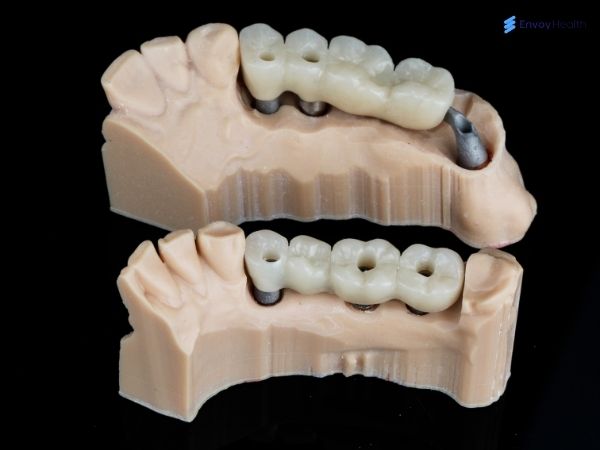
Tooth Bridge Procedure and Types
Dental bridges are custom-crafted prostheses. Dentists perform the procedure over a few dental visits. Your procedure starts with an initial consultation, during which your dentist will examine your oral cavity, the missing tooth gaps, and take X-rays. They will prepare the teeth on either side of the tooth gap by removing some enamel.[2] Next, they collect the tooth impressions and send them to the dental laboratory for custom preparation of bridges. Your dentist will fix a temporary bridge, and you will return home. Once the permanent bridge is ready to be fixed, dentists use dental adhesive to attach it, removing the temporary one. Dental bridges come in different types and can be traditional, cantilever, Maryland, or implant-supported, depending on the requirements.
Traditional dental bridges are the conventional type that feature pontic teeth attached to crowns on either side. Dentists prepare the healthy teeth on either side to fix them in place. Cantilever dental bridges, on the other hand, come with a single crown attached to the pontic teeth. Dentists prepare teeth on one side of the missing tooth gap to fix it. These do not offer as much strength as the traditional dental bridges. However, cantilever bridges are ideal when the missing teeth gaps have healthy teeth on only one side. Maryland bridges are bonded to the back of the teeth using supporting wings. While these avoid the need for tooth preparation, they do not provide sufficient strength. Further, Maryland bridges are most often used for front teeth, while they are not ideal for molars and premolars. Implant-supported bridges are fixed to dental implants surgically placed in the jaw. These are sturdy and durable and involve an intensive procedure.
How Much Does a Dental Bridge Cost Without Insurance?
Dental bridge treatment costs range between $1,500 and $16,000 in the United States. The exact cost depends on the bridge type, the number of missing teeth, the dentist, and the clinic location. Generally, the more missing teeth, the more will be the treatment cost. A 1 tooth bridge cost is generally less compared to the 3 tooth bridge cost or a 4 tooth bridge cost. While costs are a major concern for most patients, insurance can be of great help in this aspect.
Does Insurance Cover Dental Bridge Cost?
Most insurance plans cover (either partially or fully) major restorative dental treatment. Since dental bridges are a major restorative procedure, insurance in the United States covers 50-80% of the costs. However, it's important to note that the insurance coverage applies only to medically necessary cases. A typical dental bridge tooth cost with insurance ranges from $750 to $1,500; the exact cost depends on several factors. On the other hand, implant-supported bridge costs range from $1,500 to $3,000 with insurance, but this varies widely depending on the insurance type. Before diving into the factors, let's understand how insurance actually works for dental treatment.
How Does Insurance Work for Dental Bridge Treatment?
Insurance coverage applies to medically necessary dental bridges. You get partial coverage ranging from 50% to 80% for bridge treatment deemed medically necessary. For this:
- You will first plan your insurance and know its terms and conditions.
- Then you visit your dentist, get yourself diagnosed and evaluated, and understand the type of bridge treatment, its cost, and the treatment procedure and duration.
- Next, you will receive a pre-authorization letter to submit to the insurance provider.
- They will then review your request and plan benefits. Further, they provide you with a clear estimate of the annual maximum that applies to your condition.
- Then you will begin the treatment by approving the estimate. For this, your dentist will schedule the appointments required for treatment.
- Once the treatment is completed, obtain a final claim from your dentist’s office and submit it to your insurance provider.
- The insurer reviews everything and pays its share directly to the dentist’s office (applies for an in-network dentist). However, if an out-of-network dentist treats you, the insurance pays you a reimbursement instead.
- In either of the cases (whether in-network or out-of-network dentist), you will be paying your share of the bill directly to the dentist’s office.
Here are a few points you need to know before planning dental bridge insurance.
Medical Necessity
Insurance coverage applies to dental bridges only when the treatment is considered medically necessary, meaning the missing tooth affects your ability to chew, speak, or maintain proper oral function. In such cases, the bridge is considered essential to your health. However, coverage does not apply if the dental bridge is performed solely for cosmetic reasons, such as improving the appearance of a tooth gap that does not affect function or oral health.
Pre-Authorization
Pre-authorization is another major clause most dental insurance providers have; it does not directly change the exact price coverage. It actually defines and clarifies the amount the insurance pays and how much you will have to pay at the end. Your dentist will send a treatment plan, which the insurer reviews and confirms the amount they will pay. While this confirms your eligibility for insurance coverage, it also helps you understand the price breakdown and avoid unexpected bills.
In-network Dentist
Choosing an in-network dentist for bridge treatment will save you pretty much compared to choosing an out-of-network dentist. Check your insurer's provider directory, which is typically online on their website. Once you find the network dentists, call your insurance provider and confirm whether the dentist or dental group you’ve chosen is within their network. Finally, call the dentist's office to confirm whether they are in-network with the specific plan and whether they file claims directly with the insurer.
Further, many dental offices list the insurance plans they accept. You can check with the dental office directly and then contact your insurance provider to understand your coverage details, out-of-pocket costs, and the best way to plan your treatment budget.
Factors That Influence the Dental Bridge Cost With Insurance
The average cost of dental bridge with insurance cannot be the same for every patient. It actually depends on various factors such as:
- Coverage percentage: The coverage percentage is the portion of the dental treatment cost that the insurance pays for you. For example, if your insurance policy defines it to pay 50% of the costs, you will pay the remaining 50% out of pocket. Suppose the policy has specified a 70% coverage of treatment costs, you will pay 30% out of pocket. So the higher the coverage percentage, the less you will spend out of pocket.
- Annual maximum: The annual maximum is the total amount your dental insurance pays for your treatment within a year. Suppose the insurance plan specifies that it will pay around 50% of the costs, and you have already undergone other dental work, such as cleanings or fillings. In this case, the insurance only pays for bridge treatment until the annual maximum is reached. This caps your insurance coverage, and any additional costs are to be paid out of pocket.
- Waiting period: Many dental insurance plans require a waiting period before treatment is available. This clause is to prevent people from signing in only when they have a major treatment. Suppose your wait period isn’t over, and the insurance does not cover the portion of the treatment. Planning the procedure until the wait period ends can ensure you avail a maximum coverage.
What Is the Best Dental Insurance for Bridges?
There is no specific best insurance for bridge treatment. It typically depends on treatment cost, insurance coverage, and your budget. Furthermore, you should choose between the two types of dental insurance. PPO (Preferred Provider Organization) and DHMO (Dental Health Maintenance Organization) are the two formats in which insurance plans operate. While both aim to reduce treatment costs, they differ in how they work.
|
PPO Plan |
DHMO plan |
|
Offers you more flexibility to choose in-network and out-of-network dentists, but comes with higher monthly premiums. Insurance offers for choosing an out-of-network dentist for bridge treatment. |
Often come with lower premiums and predictable co-pays, but limit you to choosing in-network dentists. Insurance does not pay for reimbursement when you choose an out-of-network dentist. |
Here are a few dental insurance plans that most people use for dental bridge treatment in the United States.
- Delta Dental: Delta Dental insurance offers DHMO and PPO plans. It is one of the largest and trusted insurance plans. The plan offers 50-80% cost coverage for major restorative procedures like dental bridges. Choosing in-network dentists will lower the out-of-pocket costs. However, you must meet a specified mandatory waiting period (6,12, or 24 months) to qualify for coverage.
- Cigna: The Cigna insurance pays 50% of the dental bridge treatment cost after the specified deductible is met. Note that you will have to pay the remaining 50% of the treatment costs out of pocket.
- Guardian: The Guardian PPO plans are popular for offering 50% cost coverage for major restorative procedures such as dental bridges. As a PPO plan, it offers the option of in-network or out-of-network dentists, and the coverage percentage varies slightly depending on the choice.
- Humana: The Humana insurance will pay a portion of the bridge cost (around 50% treatment costs) after meeting the deductible. You will pay the remaining 50% of the cost and any other costs related to the treatment. Choosing an in-network dentist will ensure better coverage.
- Aetna: Aetna partially covers dental bridge costs once the deductible is met. The amount of coverage varies based on your choice of an in-network dentist. You will need to provide a pre-authorization letter before planning your treatment.
- United Healthcare: United Healthcare pays 50% of bridge treatment costs within annual limits. However, the insurance coverage applies provided you choose an in-network dentist and wait 6-12 months.
- Blue Cross Blue Shield: The Blue Cross Blue Shield (BCBS) insurance in the US operates under state plans and does not follow a single nationwide plan. But most BCBS state plans have the common features of a mandatory wait period of 6-12 months, requirement of a pre-authorization letter. Besides, choosing an in-network dentist will reduce your out-of-pocket expenses.
- Aflac: The Aflac insurance covers about half of bridge treatment costs, typically after a wait period. Coinsurance is either paid directly to the dentist's office or reimbursed. Note that coverage and waiting periods vary by specific Aflac plan.
What Expenses Do You Pay When Opting for Insurance To Cover Dental Bridge Treatment?
While planning for insurance to pay for dental bridge treatment, expect to pay the following expenses by yourself:
- The deductible you pay for insurance before the coverage begins for treatment.
- Your share of the bridge treatment expenses (apart from what the insurance pays) varies based on the insurance plan and your choice of in-network and out-of-network dentists.
- The charges that apply to any preparatory procedures. It includes diagnostic tests like X-rays, teeth cleaning, gum disease treatment, and tooth extractions.
Are There Any Alternative Ways To Address the High Cost of Dental Bridges?
Look out for any of the following approaches if you are uninsured and seeking dental bridge treatment. They can help you meet dental requirements while avoiding high costs.
- Dental discount plans: A few dental clinics offer discount plans on treatment costs as part of promotional offers. Some offer membership access, allowing you to avail discounted treatment prices. These typically apply with terms and conditions specific to the clinic.
- Dental financing: Financing is available through third-party lenders or in-house payment plans offered by some clinics. These options divide your total treatment cost into smaller, manageable monthly payments, making a bridge more affordable upfront. Generally, you apply for a credit-based loan, and once it’s approved, the lender pays the dental clinic directly for the procedure. You then repay the loan in monthly installments based on the terms you selected, often with fixed interest rates or, in some cases, promotional zero-interest periods if paid within a specific timeframe.
- Partial dentures: These removable dental prostheses are a simple, less expensive treatment approach. They cover gaps left by few missing teeth and come with a metal or acrylic frame with clasps holding false teeth. However, partial dentures do not contribute to tooth or jawbone health and are chosen as a temporary solution.
- Dental implants: Implants are a permanent, long-lasting alternative to dental bridges. They function like natural teeth and can last a lifetime with proper care. However, they are more expensive upfront and require a longer treatment timeline, including surgery and healing time. Implants may also require sufficient bone density, and not all patients qualify without additional procedures like bone grafting.
Final Word!
The cost of a dental bridge with insurance depends on your coverage, the type of bridge you need, and your dentist’s network status. Still, insurance can significantly reduce your expenses when the treatment is medically necessary. Most plans cover dental bridges as a major service, offering 50-80% coverage after deductibles and waiting periods. Understanding your policy details, getting a pre-treatment estimate, and choosing an in-network dentist can help you avoid unexpected costs and make the treatment more affordable. With proper planning and insurance, restoring your smile with a dental bridge becomes a predictable, manageable expense rather than a financial burden.
To make your dental journey easier, clearer, and more affordable, let Envoy Health guide you. Our team connects you with vetted clinics, helps you understand your treatment options, and supports you at every step, from your first question to your final smile. If you want clarity, confidence, and expert-backed choices, sign up with Envoy Health to make it happen.
References
Ready to compare Dental Work options?
Get clinic options, pricing guidance, and recovery expectations from Envoy Health before taking the next step.
Disclaimer
The information in this article is for educational purposes only and does not replace medical advice. Always consult your doctor before starting any treatments.
Published by Envoy Health. Reviewed for patient-safety framing by Envoy Health Medical Content Review. See our editorial, AI-assistance, and medical review policy.
To request a correction, email contact@envoyhealth.io with the page URL and supporting source.
Compare reviewed clinics, pricing guidance, and recovery expectations before you commit.
Dental bridges are cheaper than implant treatment, mainly because of the materials and less invasive procedure. Although both are customized procedures that offer reliable results, dental implants cost around $5,500 and can reach $55,000. On the other hand, dental bridges cost $1,500 to $16,000. The bridge treatment is less invasive and does not involve surgery. However, implants require surgical placement of the implant post in the jaw. The material costs for implants, abutment, and crown make this treatment more expensive.
A single tooth bridge costs between $1,500 and $5,000 in the United States. These single-tooth dental bridges come with a single tooth on one side of the missing tooth and are called cantilever dental bridges. They are ideal when the missing tooth has no healthy tooth on both sides to support a traditional bridge, making them suitable for cases where only one adjacent tooth is available for anchoring.
A 2-tooth bridge costs between $1,500 and $6,000 in the United States, with exact costs varying with material type, dentist, and clinic. This traditional dental bridge usually consists of a single pontic with abutment teeth on either side, forming a three-unit device that is fixed in the tooth gaps. Note that these 3-unit bridge cost with insurance are much affordable, saving you up to 50% treatment costs. However, insurance applies only to medically necessary dental bridges.
Planning for insurance is a better way to afford a dental bridge. Insurance pays 50-80% of bridge treatment costs, depending on the insurance plan. Note that you require a pre-authorization from the dentist, along with a certificate stating that the bridge procedure is medically necessary. Delta Dental, Humana, Aflac, UnitedHealthcare, and Blue Cross Blue Shield are among the most popular insurance plans that cover restorative dental procedures, such as bridges, in the United States.
The Delta dental bridge cost is nearly 50-80% lower than the regular costs. Delta Dental is one of the most popular insurance plans for restorative procedures, such as bridge treatment.
Dental bridge cost after insurance varies with the insurance plan, bridge type, and your choice of in-network and out-of-network dentists. Generally, insurance covers 50-80% of the costs, so your share of pay will be the remaining portion, along with the additional costs of diagnostic tests and other procedures such as cleanings or extractions.
So, we partner with the premier healthcare facilities!







Send me the list