Dealing With A Scar Hair Transplant: What Nobody Tells You Before The Procedure

Compare hair transplant clinics before you commit
Get clinic options, pricing guidance, and recovery expectations from Envoy Health before taking the next step.

Key Takeaways
- Scars from hair transplants are permanent and are an outcome of the body’s healing mechanism (collagen deposition) at the incision wounds. Hypertrophic and normal flat scars are masked by the surrounding hair. Keloid scars are tough, compromising the aesthetic results. The uneven-surfaced, atrophic scars are serious and require medical attention.
- The chosen hair transplant technique, the candidate’s wound-healing ability, and the surgeon’s precision, graft depth, angle, and density affect the severity of the scar.
- Treatment varies with the severity of the scar and may include scalp micropigmentation, trichopigmentation, laser therapy, microneedling, FUE on the scar, and scar revision surgery. Hair transplant scar removal cost depends on the scar's severity, the chosen method, and the number of sessions required.
Still worried about pain or recovery?
Most discomfort depends on technique, graft count, anesthesia, and aftercare. Envoy can help you compare clinics that explain the pain-management plan up front.
Hair Transplants and Scars
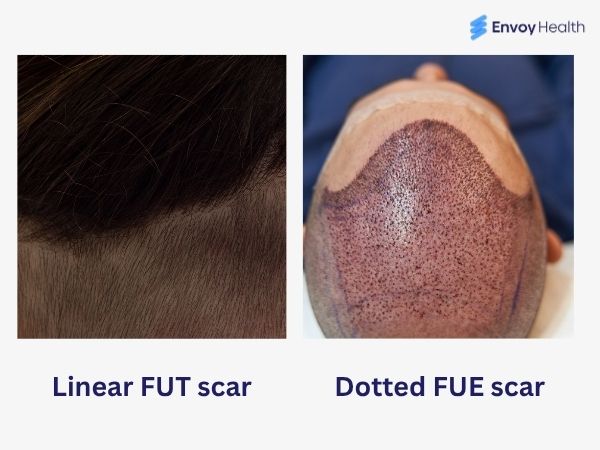
Hair transplant surgeries address crown balding by removing hair follicles from the donor area and positioning them into the recipient area. The minimally invasive procedure involves tiny incisions that leave marks on the scalp as the skin tissue heals. While most scars are mild and invisible, their visibility is popularly understood to vary by the hair transplant technique. The most commonly discussed point is that FUT leaves a long, linear scar, whereas FUE and DHI hair transplants are scarless methods. However, the reality hits different. FUE and DHI are not scarless methods, but they rely on micropunches, leaving tiny, pale dots in the donor area. These are much smaller and milder than the linear scar left by the conventional FUT hair transplant. The FUT method involves removing a long, thin strip of scalp tissue containing hair follicles. Individual grafts are harvested from the strip, and the remaining skin edges on the scalp are closed with sutures.
Understanding Why Hair Transplant Scars Form
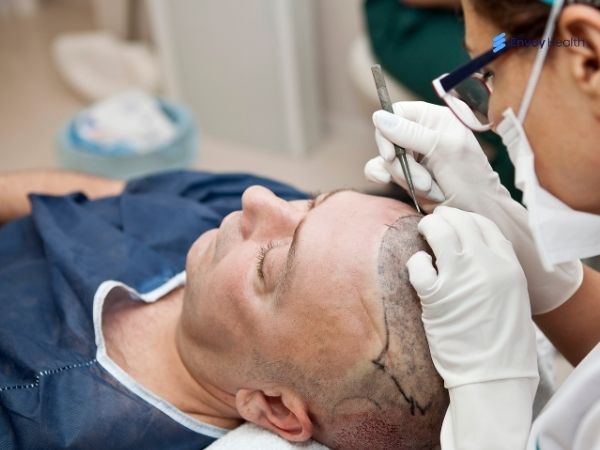
Hair transplant scars form because the procedure involves surgical cuts for graft harvest. Whether follicles are extracted using a micropunch tool (FUE) or removed as a strip (FUT), the process triggers the body's natural wound-healing response. And where there is healing, there is always some degree of scarring. Fibroblasts produce extra collagen to close the wound as part of the body’s normal healing mechanism.[1] However, the repair is rapid, forming dense collagen bundles, and the resulting new tissue differs slightly from the original surrounding tissues, leaving a “scar” appearance.
How do Hair Transplantation Scars Appear?
The “normal” scars after a well-performed hair transplantation surgery are either a linear scar (FUT) or tiny, pale, and dot-like (FUE) on the donor area. Typically, these are undetectable and barely visible when you shave your head or keep your hair too short. In most candidates, the surrounding strands of hair conceal them. A few scars may appear bumpy and raised. This occurs when the grafts are placed too shallowly or have an excess of epidermis around the follicle. In either case, the healing skin pushes the hair implant above the scalp surface, resulting in a bumpy appearance. Although the grafts survive and continue their growth, this leaves a cobblestone-like appearance on the scalp.
Types of Hair Transplant Scars
Below, we detail the types of hair transplant scars, regardless of the technique used.
- Normal, flat scars: The normal FUT and FUE scars are an outcome of the body’s healing pathways. The thin, horizontal line after a FUT hair transplant appears pink or white during the initial days. After complete healing, it fades to skin color and appears slightly raised. The DHI and FUE hair transplant scars are multiple, small, circular, dot-like across the donor areas. The small pink dots fade to skin color with complete healing. Either of these scars (FUT, FUE, or DHI) is concealed by the surrounding hair and is barely visible when the hair is grown to normal length. In rare cases, they may be visible and awkward when the extraction is aggressive and concentrated in one area.
- Hypertrophic scars: These have a raised, red colored appearance and are strictly confined to the incision or puncture wound. To the touch, these feel like thick, textured, raised bumps. While these are a result of the body’s normal healing response, the hypertrophic FUT hair transplant scars are more prominent compared to FUE or DHI procedures. The difference lies in the procedure of implant harvesting. FUT involves linear tissue excision, which causes severe mechanical tension and trauma, leading to excessive collagen production and the formation of a thick, raised, linear scar. FUE, on the other hand, leaves numerous microwounds that heal with minimal tension.
- Keloid scars: These severe, thick, raised scars extend beyond the surgical incisions and result from an exaggerated immune response.[2] Unlike normal scars, these are purple-to-red, firm, shiny, and raised, showing continuous growth over months. While not dangerous as such, these can be seriously distressing aesthetically. While some keloids may be itchy, tender, and painful, the real issue arises when they destroy or damage hair follicles, making hair regrowth impossible.
- Depressed, atrophic scars: These appear as small, shallow, sunken indentations with a noticeably uneven texture. They present as pitted areas, usually beneath the healthy scalp skin, and may occur in both the donor and recipient areas. Atrophic scars result from poor healing, infection, lack of adequate blood supply for growing grafts, or other surgical complications. Creating too deep incisions into the dermal layers causes delayed healing, resulting in atrophic dimples. Continued inflammation of the tissues around hair follicles may lead to tissue loss, which appears as an uneven, pitted surface. These are not medically serious in most cases unless the scar surface is oozing fluid and is red and warm.
Comparing Hair Transplant Scar Types
|
Feature |
Normal scars |
Hypertrophic scars |
Keloid scars |
Atrophic scars |
|
Appearance |
Thin, tiny, pink colored that fades with healing |
Red colored, raised bump-like, confined to the incision site |
Severe, thick, raised, purple to red colored spreading scar with continuous growth |
Pitted, uneven, sunken surface |
|
Visibility |
Concealed by hair |
Concealed by hair |
Noticeable |
Noticeable |
|
Cause |
Normal healing |
Excessive collagen production during healing |
Exaggerated healing response with excessive collagen |
Poor healing, infection, and surgical complications |
|
Area on the scalp |
Donor area |
Donor area |
Donor area |
Donor and recipient areas |
|
Seriousness |
Minimal, no treatment needed |
Minimal, no treatment needed |
Moderate, check for progression |
Moderate to severe, requires medical attention |
|
Associated procedures |
FUE, FUT, DHI |
More chance for FUT |
More chance for FUT |
FUE, FUT, DHI |
Are Hair Transplant Scars Permanent?
Yes, hair transplant scars are permanent, but their visibility varies greatly depending on the chosen hair transplant method. The scar tissue formed by collagen production is permanent and does not fade over time. But the appearance of the scar changes over time. The reddish-purple color fades to a pale shade, making the scar masked by surrounding hair.
Does a Hair Transplant Cause Scars in Every Candidate?
Yes, every candidate who undergoes a hair transplant procedure is likely to develop scars. But the extent of their visibility is not the same for all. Hair transplant scars are a result of the body’s natural healing process. Any hair transplant procedure involves incisions to some extent, so scars are an inevitable consequence. However, the severity of scars depends on the chosen technique, the surgeon’s expertise, aftercare, and candidates healing ability.
- Hair transplant technique: FUT scars are prominently noticeable compared to the FUE and DHI scars, primarily due to the graft harvest method. FUE and DHI rely on micropunches to harvest grafts, creating precise, circular wounds that heal quickly and leave tiny, barely visible dots. FUT, the strip method involves a linear cut on the donor area, creating a long scar of tissue.
- Surgeon’s expertise: Any surgical procedure leaves scars, but the goal is to minimize their visibility. Too aggressive punching leaves visible marks and hypertrophic scars. Too dense graft packing in the recipient area limits blood supply, increasing the likelihood of scar formation. Adopting advanced suturing techniques to reduce wound tension, such as trichophytic closure, reduces collagen production, leading to flatter and thinner scars. Scalp laxity and tissue elasticity are important determinants of tissue tension during wound closure. In fact, these influence the collagen production and the severity of the scar.[3] Skilled and experienced hair transplant surgeons assess scalp laxity and skin elasticity using modern technology before recommending the appropriate method. Not just that, skilled hair transplant specialists have better control of depth, angle, and punch size for graft extraction.
- Individual’s body healing: Understanding the risk profile will help gain a clear picture of the overall aesthetic results to expect. Individuals with insufficient scalp elasticity are more likely to develop visible scars after FUT. FUE can be the right choice. Individuals with keloid or hypertrophic scar history are likely to develop problematic, visible scars. Studies suggest that candidates with habits like smoking and those suffering from diabetes are prone to a risk of tissue necrosis, leading to permanent scarring and procedure failure.[4] Genetics also plays a role in scar formation. Your genes dictate the body’s healing capacity and collagen production. In fact, these are the primary drivers of hair transplant scar visibility. Candidates having darker skin tones are more likely to develop hyperpigmentation around the incision sites. According to a few review studies, individuals of African-American, Latino, and Asian descent are more likely to develop keloid scars. Candidate selection is crucial at this point.[5]
- Adherence to aftercare: Candidates failing to adhere to effective post-treatment care are more likely to develop infections and inflammation. Failing to clean the scalp, heavy-weight routines, and direct sun exposure affect the blood supply and the microenvironment around the growing implants. Poor scab management and disrupted blood flow disturb the scalp healing, leading to scar formation.
Timeline: When Do Hair Transplant Scars Go Away?
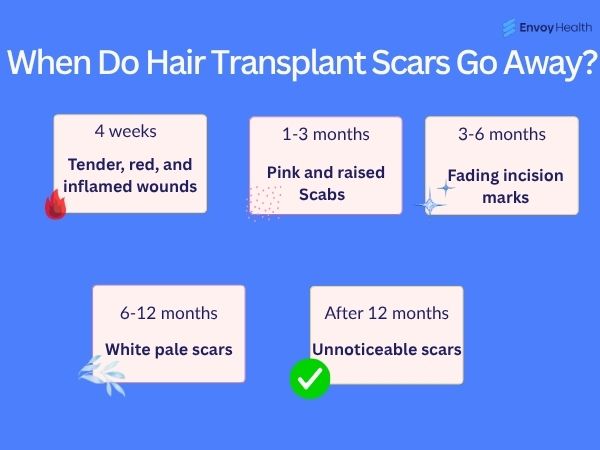
Hair transplant scars do not go away, but they fade over time when the technique is properly performed, and grafts are taken with care. Hair transplant scar healing time largely depends on hair regrowth and the individual’s healing capacity.
- 1-4 weeks: Fresh incision wounds with the donor and recipient sites tender, red, and inflamed.
- 1-3 months: Grafts experience shock loss, and the scabs appear pink and reddened, with a raised appearance.
- 3-6 months: New hair emerges out of the grafted follicles and starts masking the fading dotted graft scars and linear incision marks.
- 6-12 months: Faded and flattened scars. The surrounding hair is long enough to conceal most scars, which appear whitish or pale when viewed closely at this stage.
- After 12 months: Scars in the final stage, completely unnoticeable by the surrounding hairs.
What is the Best Hair Transplant Scar Treatment?
A better approach to treating existing scars from a hair transplant depends on scar type, location, and thickness. Hair transplant specialists suggest the right one for your case, depending on your goal: whether to camouflage visible areas or to refine the scar tissue medically or surgically. The hair transplant scar removal cost varies with technique, severity of scar, and the number of sessions required.
- Camouflage techniques: These include non-surgical cosmetic methods to hide dotted and linear areas of FUE, DHI, and FUT. Scalp micropigmentation and tricopigmentation are the two popular methods. Scalp micropigmentation (scalp hair tattooing or medical hairline tattooing) involves pigmenting the scalp to mimic the surrounding hair follicles. The color shade for this permanent approach is chosen based on the natural hair color. Tricopigmentation is a semi-permanent method of inking the scalp's upper dermal layers. The results last for 6 months to 3 years.
- Surgical revision: This involves surgical procedures to repair visible, more noticeable scars after a hair transplant. Scar revision surgery is chosen for tough, linear FUT scars. Surgeons excise the old scar tissue and suture the skin using advanced closure techniques to reduce tissue tension, resulting in a thin, flat scar that is easily concealed. Another approach is placing hair grafts into the linear scar using the FUE method. Studies suggest that FUE yields better outcomes with adequate hair growth over the scar tissue.[6] Note that the effectiveness of the result depends on the scar's thickness. The ISHRS states that scar tissue lacks a normal blood supply, making hair regrowth difficult.[7] So most hair transplant specialists prepare the scar tissue using methods such as PRP to promote optimal growth.
- Non-invasive medical approach: Non-invasive methods for treating hair transplant scars rely on advanced techniques and may require multiple sessions, depending on the chosen approach. In some cases, combinations are used for better cosmetic results. Laser therapy targets and removes damaged scar tissue by breaking down tough tissue and resurfacing the area. This results in healthy collagen production and flattening of the reddened, raised, tough scars. Microneedling is another approach for creating tiny microinjuries in scar tissue. The result is a smoother, softer skin through a natural healing response to the microinjury. Note that the effectiveness of the results largely varies with the density and thickness of the scar tissue. Topical serum and silicone-based gels are also recommended to keep the skin hydrated and soft during the initial healing days following the non-invasive approach.
Hair Transplant Scar Removal Cost
The cost of hair transplant scar removal ranges between $500 and $15,000 in the United States. It typically varies depending on the procedure and the severity of the scar. Scar hair transplant costs range from $2,500 to $15,000 and are typically higher than those for non-invasive procedures. The cosmetic fixes, such as scalp micropigmentation and laser therapy, are charged on per session basis. These typically range between $400 and $2,500 per session. Note that the total cost of non-invasive methods varies with scar severity, which determines the number of sessions needed.
Ways to Avoid Hair Transplant Scar
While you cannot avoid a hair transplant scar, you can definitely minimize its severity. In fact, it starts before the procedure itself. All you need to do is: Choose the right hair transplant technique, get it done by a qualified, skilled professional only after a clear medical screening, and adhere to the post-op care. With the right planning, you are not just avoiding scars or minimizing their visibility; you can also improve the longevity of hair transplant results.
A skilled surgeon can conduct an effective assessment of your candidacy and recommend an appropriate technique for your case. It can help you attain better outcomes with precision and accuracy. Verify the surgeon's qualifications, certifications, hospital accreditations, affiliations, and credentials. Transparently disclose the medical history, any previous surgical experiences, and ongoing medications with your hair transplant specialist. Strictly follow the aftercare as specified by your hair transplant specialist. Quit smoking and alcohol consumption for a few months before the hair transplant procedure.
Final Word
Scar hair transplants can be concerning, compromising the overall look. While scars are unavoidable, there are ways to minimize their visibility. With the right technique, realistic expectations, and proper aftercare, most hair transplants heal with minimal traces. And if you are worried about the existing hair transplant scars, there are ways to address or conceal them.
At Envoy Health, we connect you with specialists who take the time to assess your individual scar risk, recommend the right technique for your skin type, and support you through every stage of your hair restoration journey. Sign up today and get matched with a trusted hair transplant expert.
References
- Scar Inhibition in Wound Healing: Mechanisms, Design, and Recent Advances
- Keloid Scars Arising after Follicular Unit Extraction Hair Transplantation
- Hair Transplant with Strip Harvest: Indications, Contraindications, and Technique
- Complications of Hair Transplant Procedures—Causes and Management
- Keloid Scars Arising after Follicular Unit Extraction Hair Transplantation
- Facial Scar Management by Hair Transplant: A Case Report
- Hair Restoration in the Scarred Scalp
Ready to compare hair transplant options?
Get clinic options, pricing guidance, and recovery expectations from Envoy Health before taking the next step.
Disclaimer
The information in this article is for educational purposes only and does not replace medical advice. Always consult your doctor before starting any treatments.
Published by Envoy Health. Reviewed for patient-safety framing by Envoy Health Medical Content Review. See our editorial, AI-assistance, and medical review policy.
To request a correction, email contact@envoyhealth.io with the page URL and supporting source.
Compare reviewed clinics, pricing guidance, and recovery expectations before you commit.
Yes, two patients treated by the same hair transplant specialist can have different scars. The hair transplant technique sets a baseline for the degree of scarring. And it's not necessary for two patients to undergo the same technique. More importantly, the candidate's genetics, skin type, and adherence to aftercare significantly influence scar severity.
Hair transplant scars generally itch and cause slight discomfort during their early stages of healing. They result from tissue healing and the body’s inflammatory response. However, persistent itching, continuing months after hair transplantation, are sign of delayed healing or infection. While itching with scab formation is a good sign, fluids oozing from the inflamed area should not be ignored.
Hair transplant scars cannot be prevented. Scarring after hair transplants is a result of the scalp's healing process and cannot be prevented entirely. But the extent of their visibility can be minimized notably with the choice of the right surgeon, appropriate technique, candidate selection, and adherence to post-surgical care.
So, we partner with the premier healthcare facilities!


Send me the list