Laser Eye Surgery Dangers: Here Is The Truth No One Tells You

Compare Eye Surgery options before you commit
Get clinic options, pricing guidance, and recovery expectations from Envoy Health before taking the next step.
Key Takeaways
- Laser eye surgery offers 20/20 or better vision with a high rate of patient satisfaction. The procedure reduces dependence on glasses and contact lenses, making life easier.
- Minor discomfort, including irritation, dryness, glare, halos, and light sensitivity, is expected because the lasers create a corneal flap, disrupting the nerves that control tear production.
- Problems with the corneal flap and slight vision disturbances subside with time. The chances of serious issues, including infection and blindness, following laser eye surgery are quite low. Selecting the suitable candidate and adhering to best surgical practices while following sterilization techniques ensures successful outcomes.
Still comparing Eye Surgery options?
Envoy can help you compare reviewed clinics, pricing guidance, and recovery expectations before you make a decision.
Is Laser Eye Surgery Permanent?
Laser eye surgery is considered permanent because of the irreversible changes it makes to your eyes. Most laser eye treatments correct vision problems such as difficulty seeing nearby or far-off objects, or seeing at both distances. They rely on powerful, precise lasers to reshape the cornea and lens to correct refractive errors. Treatment is simple: surgery takes around 30 minutes, with noticeable vision changes in 24-48 hours, and a simple recovery of 1-3 days. Most procedures aim to make life easier by reducing the reliance on contact lenses and glasses. Like any other medical procedure, it carries some potential risks. And if you ask us, "Is laser treatment for eyes is good or bad?” a straight answer is to weigh the positives and negatives specific to your case before proceeding with the treatment.
Laser Eye Surgery Safe
Complications due to laser eye surgery are rare, and the procedure is generally safe. Studies suggest that laser eye surgeries, such as LASIK and SMILE, have higher patient satisfaction rates.[1] Most patients experience enhanced quality of life, attaining 20/20 vision or more (in some cases). These laser eye surgery problems are temporary. It's common for patients to experience dry eye, glare, discomfort, double vision, and halos. However, these typically diminish within 3-6 months. The real problem lies in laser eye surgery side-effects long term. Although rare, the effects are serious.
Laser Eye Surgery Complications
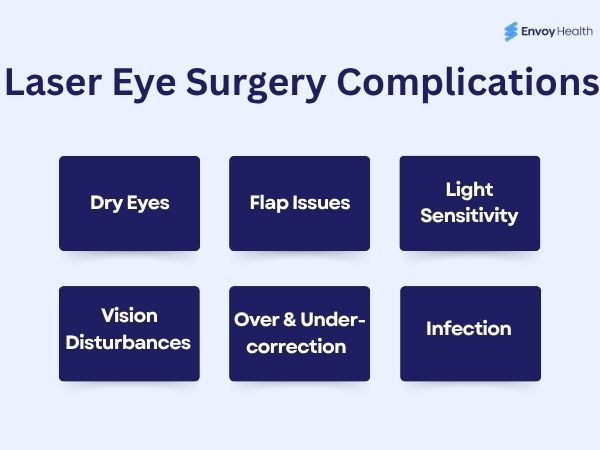
Below are some rare yet serious laser eye surgery complications:
Dry Eyes
Dry eyes is one of the common side effect that follows laser eye surgery. Most patients experience dryness during the first few months, which gradually subsides within 6-12 months after surgery. Lasers create a flap in the cornea, which disrupts the nerves involved in tear production.[2] Because of this, the eyes fail to produce adequate moisture after the surgery. Candidates experience a gritty, sandy, and burning sensation with increased irritation in windy and air-conditioned environments.
Vision Disturbances
While patients admit satisfaction with vision improvement after laser eye surgery, vision disturbances are quite common. These include light sensitivity, glare, halos, star bursts around lights, and a sudden drop in sharpness, especially during night driving. Reasons can be the eye's natural healing response, causing tissue swelling and temporary haze. Besides flap creation also causes nerve disruption, which in turn affects the tear production. Excessive dryness also causes vision issues during the early days.[3] While these can be disturbing, they are common and subside in a few months. It feels like looking through a misty window. Don’t worry, as these are temporary and subside in a few months.
Flap Issues
Eye surgeons gain access to the underlying eye tissues by creating a small flap in the outer surface of the cornea. Eximer lasers precisely lift the corneal flap and replace it in its original position. Although rare, the flap fails to heal and regain its original strength. Reasons include flap dislocation due to excessive blinking and rubbing of the eyes early after surgery. Studies suggest that flap fold issues are quite rare, ranging from 0 to 12.8%.[4] Patients experience a sandy and gritty feeling of having a foreign body in the eye.
Over and Under-correction
Lingering issues such as blurred or distorted vision and loss of sharpness can result from under- or overcorrection by the lasers. Extremely sharp vision due to overcorrection can lead to headaches and eye strain. These occur when the lasers remove too little or too much corneal tissue rather than the amount required. This attempt fails to neutralize the refractive errors, leaving behind a residual prescription. Patients require follow-up surgery to correct vision issues and improve eyesight.[5]
Light Sensitivity
Photophobia, or the feeling of intense discomfort when exposed to bright outdoors or sunlight, is quite disturbing following laser surgery. Even the normal lights can feel more intense during the early days. Although it's temporary and subsides within a few days to a week, wearing sunglasses and cutting down screen time help manage it easily. Symptoms subside in a month for most patients. However, persistent sensitivity to light and heightened discomfort delayed corneal healing due to inflammation, infection, or corneal abrasion are serious. These require prompt medical attention.
Infection
Although rare, infection after laser eye surgery is quite dangerous, leading to corneal scarring and permanent vision loss. Candidates report persistent pain with heightened intensity, eye redness, yellowish discharge, and a sudden, sharp drop in vision. Intraoperative contamination, delayed corneal flap healing, and failing to comply with the antibiotic regimen following surgery are the main reasons for infection. Prompt care is crucial because the effects can be serious: infections progress quickly, and the damage is irreversible.
Laser Eye Surgery Risks of Blindness
Laser eye surgery causing permanent vision loss is extremely rare. Most patients report satisfaction with improved vision and quality of life. It's better to see your doctor when symptoms such as persistent glare, halos, starbursts, and chronic pain do not subside and increase in intensity. Permanent vision loss can occur due to an infection, an extremely weakened and bulged cornea, or uncontrolled intraocular pressure.
The effects can be life-altering, with significant emotional distress and difficulty in performing daily life activities. The worst part is remorse and regret, since the procedure is elective and promised to improve.
Laser Eye Surgery Risk Percentage
The risk of blindness following laser eye surgery is very rare, with an incidence of less than 1%. The temporary side effects are common and unavoidable. However, easily manageable. In fact, the US FDA approves modern laser procedures for refractive error correction mainly because of 98.7% patient satisfaction rates.[6]
Reducing Laser Eye Surgery Risk
Candidate selection, having the surgery performed by the right professional in the right way, and following aftercare measures reduce the risk of complications from laser eye surgery. Choosing a skilled, experienced ophthalmologist over someone with limited experience makes a real difference.
Experienced ophthalmologists who have years of experience typically treat a wider range of vision conditions. Established ophthalmologists often work with modern lasers, advanced technology, and updated diagnostics. Rather than just performing the procedure, their expertise speaks to how they handle complex situations and achieve better surgical outcomes. While not every candidate is suitable for laser eye surgery, a comprehensive patient evaluation helps identify early risks. Not every eye problem is the same, and not all vision problems are corrected effectively with lasers. An important question to address here is, “Who should not have laser eye surgery?”
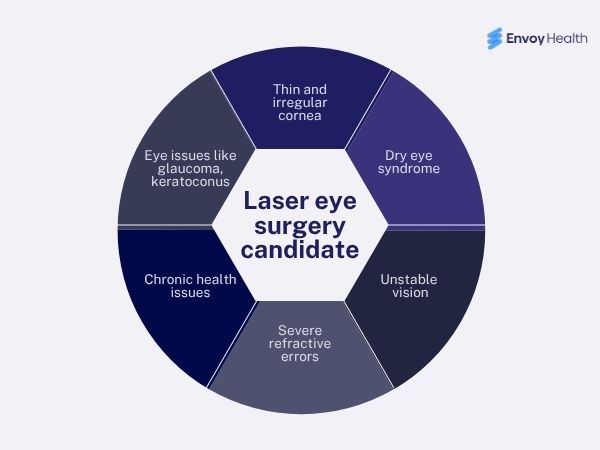
Candidates with extremely thin and irregular corneas, severe refractive errors, unstable vision, and those suffering from dry eye issues, eye problems (such as glaucoma, keratoconus), and chronic health conditions that affect healing (such as diabetes, autoimmune diseases) are not suitable for laser eye surgeries. Ophthalmologists consider the severity of the eye condition and overall eye health before choosing the type of laser eye surgery. For instance, suffering from conditions such as glaucoma makes a candidate unsuitable for LASIK. The risks of LASIK eye surgery for glaucoma are quite high, so alternatives such as PRK and LASEK are suggested. This is where the ophthalmologist's expertise and experience truly matter. Choosing the safe method and the right candidate requires careful assessment, precision, and years of experience.
Final Thoughts
Laser eye surgery promises clear vision with minimal downtime and no lengthy hospital stays. While some minor side effects are expected, as with any medical procedure, the laser eye surgery dangers are largely manageable. The likelihood of severe complications, including blindness, is very low. However, the outcomes depend heavily on selecting a skilled ophthalmologist who carefully evaluates the candidates before proceeding.
At Envoy Health, we connect you with top doctors worldwide. We prioritize quality and patient safety, so we tie up only after complete vetting. Sign up today for a quick, clear initial consultation. An expert talk can ease your mind and clear the hazy doubts, clearing the path for a crystal clear vision.
References
- Functional outcome and patient satisfaction 5y after laser vision correction
- Post-LASIK dry eye disease: A comprehensive review of management and current treatment options
- Early Impact of Laser Vision Correction (LVC) on the Stability and Quality of the Retinal Image
- Surgical and visual outcomes of flap repositioning for various flap-related pathologies post laser in-situ keratomileusis (LASIK)
- PRK for the Correction of Refractive Errors after LASIK, PKP, and RK
- Raising Awareness: Do these patients sound familiar?
Keep researching cataract and eye surgery
Explore the full cataract and eye surgery topic hubReady to compare Eye Surgery options?
Get clinic options, pricing guidance, and recovery expectations from Envoy Health before taking the next step.
Disclaimer
The information in this article is for educational purposes only and does not replace medical advice. Always consult your doctor before starting any treatments.
Published by Envoy Health. Reviewed for patient-safety framing by Envoy Health Medical Content Review. See our editorial, AI-assistance, and medical review policy.
To request a correction, email contact@envoyhealth.io with the page URL and supporting source.
Compare reviewed clinics, pricing guidance, and recovery expectations before you commit.
LASIK eye surgery going wrong is extremely rare. It is, of course, the most popular eye treatment because of its high success rate. The temporary and less serious side effects are common and easily manageable. Dryness, itching, glare, halos, and light sensitivity occur for a few days after surgery and gradually fade.
Serious risks like vision loss due to laser eye surgery are very rare. Minor side effects such as dryness, glare, halos, double vision, and light sensitivity are common during the early days after surgery. These subsides in a few months as you follow the right aftercare, and allow the sensitive tissue to heal completely.
Laser surgery is not recommended for some candidates who carry a risk of complications. Individuals suffering from dry eye syndrome, those with a thin or weaker cornea, and those with unstable vision are not recommended for laser eye surgery. The likelihood of developing complications is quite high, and in some cases, it may even lead to vision loss.
Laser eye surgery is painless because it's carried out after your eyes are numbed using eyedrops. You might experience slight pressure during the procedure. After treatment, itching, dryness, and a gritty sensation are common.
So, we partner with the premier healthcare facilities!
Send me the list