Cost of Zirconia Dental Implants: Understanding Price Without the Confusion


Compare Dental Implants options before you commit
Get clinic options, pricing guidance, and recovery expectations from Envoy Health before taking the next step.
Table of contents
Key Takeaways
- Dental implants crafted from zirconium dioxide are tooth-colored, tiny screws fixed within the jawbone through a surgical procedure under local anesthesia. Being metal-free, they do not cause allergic reactions in patients and are a safe choice.
- The cost of zirconia dental implants ranges from $1,500 to $7,000 per missing tooth. Crown costs are an additional cost beyond implant costs, priced at around $3,000.
- Zirconia implant treatment costs vary depending on the dentist, clinic, prosthesis, number of implants, anesthesia type, and the need for additional procedures. Some candidates require procedures such as tooth extraction, bone graft, or sinus lift, which will add to the overall implant treatment costs.
Still comparing Dental Implants options?
Envoy can help you compare reviewed clinics, pricing guidance, and recovery expectations before you make a decision.
A Brief on Dental Implants
Losing teeth is quite common nowadays. A survey conducted by the NIDCR suggests that adults aged 25-64 have only 25% of their teeth remaining in their jaws. Habits like smoking, poor oral hygiene elevate the incidence of tooth loss.[1] Partial and complete edentulism (condition of not having teeth in the jaw) significantly affects the quality of life. Missing teeth can create gaps that make chewing and speaking with clarity difficult. The gaps in your front teeth make your smile look awkward, evoking feelings of self-consciousness and lowering your confidence. Dental implants are an effective, long-lasting solution. These are small screw like devices fixed within the jaw to support artificial teeth. Getting them involves a surgical procedure carried out by a qualified, certified, and skilled dentist.
What Are Zirconia Dental Implants?
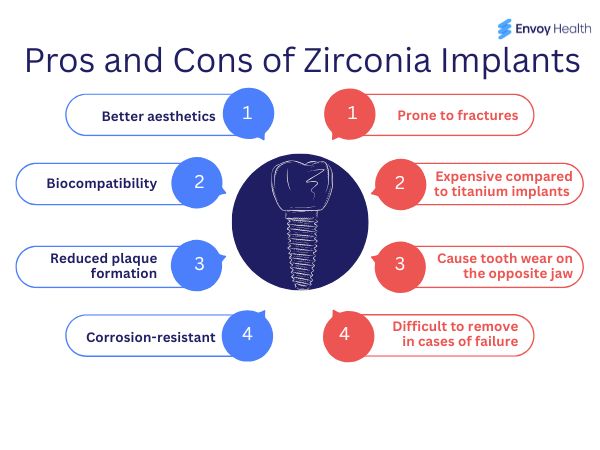
Zirconia implants are a modern type gaining popularity nowadays. Zirconia dental implants are tooth-colored, tiny screw-like devices made from zirconium dioxide. Since zirconium dioxide is a highly durable ceramic, it imparts higher strength to the implants while retaining a natural look. In fact, these are a better alternative to the traditional titanium metal implants. Since they are metal-free, candidates need not worry about the risk of inflammation. Further, these are FDA-approved, safe, and known for their effectiveness. Zirconia dental implants are available in a one-piece design (with a combined implant and abutment body) for a single unit. Alternatively, two-piece designs (with a separate implant and abutment) are also available.[2] The artificial teeth are fixed on top of either type to restore the functions of natural teeth. Knowing the pros and cons definitely matters before making a decision. Here we listed the advantages and disadvantages of the choice.
|
Advantages of zirconia dental implants |
Zirconia dental implants problems |
|
Being tooth-colored, they blend well, offer better aesthetics, and are best suited for front teeth. |
Although durable, zirconia is more prone to fractures and cracks and is unsuitable for high bite forces. |
|
Being metal-free, they reduce the risk of rejection and offer excellent tissue compatibility. |
More expensive compared to traditional titanium implants. |
|
Have an extremely smooth, non-porous surface, reducing the incidence of bacterial plaque formation.[3] |
Because they are hard ceramics, they cause tooth wear on the opposite jaw. |
|
The metal-free surface forms a thin oxide layer on the interface, making it bio-inert and corrosion-resistant within the oral environment.[4] |
Difficult to remove in cases of failure (although fails are rare). It may involve some bone removal, unlike titanium implants. |
Are Zirconia Dental Implants More Expensive?
Yes, zirconia dental implants are quite expensive compared to the traditional titanium metal implants. The higher prices are due to high material costs and advanced, complex technology. However, the high prices are worth it, because of the nature of the results one can expect. Zirconia implants offer exceptional durability and natural results, making them ideal for candidates seeking a metal-free option. In fact, they are ideal for candidates with thin gums who may show a grey streak around the titanium implants. Zirconia implants, being tooth-colored, address this issue, offering a seamless blend.
How Much Do Zirconia Dental Implants Cost?
A single zirconia dental implant in the United States costs between $1,500 and $7,000. This price range covers implants with abutment for either single-piece or two-piece implants. In addition to this price, you should expect to spend an amount between $1,500 and $3,000 for a dental crown. If you have many missing teeth, you should consider full mouth zirconia implants.
Dentists either recommend all-on-4 or all-on-6 implants, depending on the patient's requirements. Full zirconia implants cost range can go as high as $20,000 to $50,000 per jaw.
Zirconia Implants Versus Titanium Cost
The cost of zirconia implants versus titanium, is influenced by differences in material composition, manufacturing complexity, clinical handling, and long-term performance. While titanium implants are generally more affordable and widely used, zirconia implants are often more expensive due to their metal-free design, aesthetic advantages, and suitability for patients with metal sensitivities.
Factors Affecting Zirconia Implants Costs
While zirconia dental implants price is inherently higher due to the expensive material costs, the prices vary significantly based on the following factors.
- Dentist's expertise: Zirconia dental implants involve a surgical procedure, and a skilled, qualified implantologist should perform it. While a general dentist charges lower prices than an implantologist, experienced implantologists charge higher prices but deliver exceptional results. This accounts for the ongoing demand for their treatment. Thanks to their skill and expertise, and ability to handle complex cases, one can expect better treatment outcomes with an experienced implantologist.
- Clinic location: Expect higher prices at clinics located in urban metropolises. The prices are quite high due to relatively higher operational and management costs. Clinics pass the cost burden to treatment charges, which are reflected in patients' bills.
- Intensity of tooth loss and procedure complexity: The more missing teeth, the more implants are required. While single-tooth loss requires a zirconia implant with a crown, multiple missing teeth in a jaw will require full-mouth rehabilitation, which will definitely increase costs.
- Additional pre-treatment procedures: Depending on the oral health condition and jawbone quality, some patients require additional procedures. It may include, but is not confined to, a bone graft, sinus lift, or tooth extraction. These costs are added to the overall treatment costs, further increasing the financial burden.
- Type of prosthesis: The overall treatment costs vary depending on the prosthesis type you choose. Generally, dental crowns made from porcelain or porcelain-fused-to-metal cost less compared to zirconia dental crowns. And when you choose full-arch restorations, costs rise sharply, as reflected in the final treatment bills.
- Anesthesia and sedative choices: The dental implant surgery is performed under anesthesia. Some dentists prefer local anesthetics, while a few others recommend sedatives, especially for candidates with anxiety. A few more advanced clinics adopt nitrous oxide sedation as laughing gas. These help the patient relax during the procedure. However, the costs vary widely different which can significantly affect the overall treatment bills.
Procedure for Zirconia Dental Implants
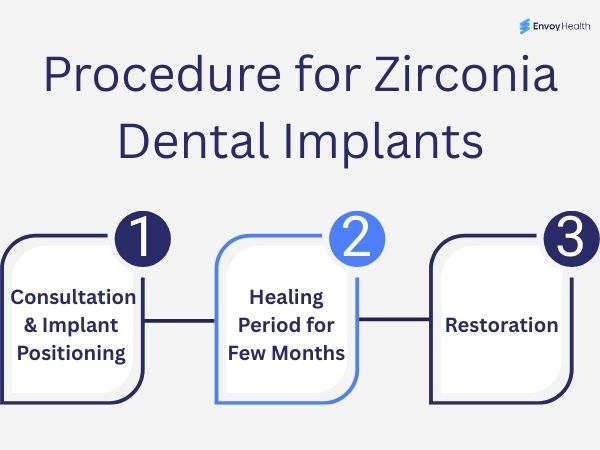
Dentists surgically fix these in place of missing teeth within the jaw. Over time, they gradually fuse with the surrounding jawbone, forming a strong bond through osseointegration.[5] Thereby, these behave as natural tooth roots bearing artificial teeth on top. This requires a stage-wise procedure spanning 6-12 months. Below, we detail the step-by-step procedure for getting zirconia dental implants.
Stage 1: Consultation and Implant Positioning
- You will attend the initial consultation, during which your dentist will check the gums and your teeth and gums to assess your oral health.
- They will perform a few diagnostic tests to assess the quality of your jawbone. Having an adequate jawbone to hold the implant is quite essential.
- Once you are identified as an eligible candidate, the dentist explains the procedure, its pros and cons, and provides a detailed price quote.
- The implant surgery is carried out under local anesthesia. Dentists inject an anesthetic so you don't feel any pain. They make an incision in your jaw at the site of the missing tooth.
- They drill tiny holes in the jawbone to place the zirconia implants, then close the gum incisions with sutures.
- Dentists collect tooth impressions for customized tooth preparation and cover the implant posts using temporary crowns.
Healing Period for Osseointegration
- Your jaws are left to heal for around 3-6 months. During this period, the implants fuse with the jawbone, forming a strong bond.
Stage 2: Restoration
- Dentists will examine the extent of osseointegration by performing a few dental X-rays. After ensuring that the implants formed a strong bond with the jawbone, dentists will remove the temporary crowns and fix the abutment and permanent prosthetic teeth.
Are Zirconia Dental Implants Right for You?
Being metal-free, zirconia dental implants are ideal if you are looking for a long-term, plaque-resistant solution to tooth loss. They are a perfect choice if you:
- Have thin gums
- Are suffering from metal allergies
Here are the common symptoms you might notice when you are allergic to metal implants.[6]
- Localized inflammation on the gums with redness
- Swollen and sore gums
- Burning sensations wth persistent irritation
- Itching around the implant site.
How Do You Detect Titanium Metal Allergy?
It's crucial to know about allergies before planning implant treatment. Convey clearly any potential allergies to your dentist before planning treatment. Dentists conduct the following tests before planning treatment.
- Patch test: Dentists apply a patch of titanium oxide or titanium sulphate to the skin and check for an allergic reaction.
- MELISA test and Lymphocyte transformation test: These are specialized blood tests that measure lymphocyte proliferation and response to titanium.
Why Are Zirconia Implants Getting Popular Nowadays?
Although zirconia implants lack sufficient clinical data, they are gaining popularity today. The superior aesthetics, excellent biocompatibility, and metal-free composition make them a stronger alternative to titanium implants, which is driving their popularity. Their plaque-resistant surface reduces bacterial buildup, increasing the likelihood of long-term survival. Furthermore, zirconia implants are known for their long-term survival, making them a well-chosen alternative for long-term implants.
Final Word!
In the end, understanding the cost of zirconia implants is about looking beyond the price tag and weighing long-term value, biocompatibility, durability, and aesthetic outcomes. While zirconia implants typically cost more upfront than traditional titanium options, many patients consider the investment worthwhile for their metal-free composition, natural appearance, and compatibility with sensitive tissues. However, the total cost varies widely depending on factors including the number of implants needed, the complexity of the procedure, the dentist’s expertise, and any additional treatments required. For patients considering zirconia implants, informed discussions with a qualified dental professional are essential to determine whether the benefits align with personal health needs, expectations, and budget. A thoughtful evaluation of both clinical outcomes and costs helps ensure the final decision supports not only a healthier smile but also long-term satisfaction.
For patients who want clarity and trusted guidance, signing up with Envoy Health can simplify the process by connecting you with vetted clinics, providing transparent cost information, and offering personalized support so that you can move forward with confidence and an informed choice.
References
- Tooth Loss in Adults (Age 20 to 64)
- One-piece versus two-piece ceramic dental implants
- Assessment of osseointegration mechanisms in a novel zirconia implant: From experimental insights to clinical comparison
- A comprehensive review: surface modification strategies to enhance corrosion resistance of zirconia-based biomaterials in implant applications
- The Future of Dental Implants: A Narrative Review of Trends, Technologies, and Patient Considerations
- Allergies to Titanium Dental Implants: What Do We Really Know about Them? A Scoping Review
Ready to compare Dental Implants options?
Get clinic options, pricing guidance, and recovery expectations from Envoy Health before taking the next step.
Disclaimer
The information in this article is for educational purposes only and does not replace medical advice. Always consult your doctor before starting any treatments.
Published by Envoy Health. Reviewed for patient-safety framing by Envoy Health Medical Content Review. See our editorial, AI-assistance, and medical review policy.
To request a correction, email contact@envoyhealth.io with the page URL and supporting source.
Compare reviewed clinics, pricing guidance, and recovery expectations before you commit.
Zirconia implants are considered elective and are not fully covered by insurance. Some insurance plans offer partial coverage for medically necessary zirconia implants. A few also cover some portion of the treatment, usually the crown (artificial tooth) portion. However, note that the cost of zirconia dental implants with insurance varies with the insurance provider, dentist, and prosthesis type. For instance, a single zirconia implant with a crown will cost you less than a full-mouth restoration of implants and a zirconia dentures price.
Yes, dental implants are more expensive than crown treatment. Tooth implants involve a surgical procedure, and a single implant will cost you around $5,000. Suppose you need a full mouth restoration. The costs can fall anywhere between $30,000 to $50,000 per jaw. On the other hand, a single dental crown costs between $2,500 and $3,000.
The average cost of zirconia dental implants ranges from $1,500 to $7,000. The overall treatment costs can be higher, considering the additional costs of crowns priced around $3,000.
Zirconia crown cost per tooth ranges between $1,500 and $3,000. While these prices are slightly higher than those of traditional titanium implants, they are still worth the price due to their excellent natural aesthetics, durability, and long-term benefits.
Zirconia implants are better than traditional titanium implants because of their better aesthetics, plaque resistance, and metal-free composition. They are tooth-colored and seamlessly blend with the surrounding teeth, without the potential metal allergies that titanium implants can cause.
So, we partner with the premier healthcare facilities!


Send me the list