Thinking About Eye Surgery for Lazy Eye? Here’s What Matters

Compare Eye Surgery options before you commit
Get clinic options, pricing guidance, and recovery expectations from Envoy Health before taking the next step.

Key Takeaways
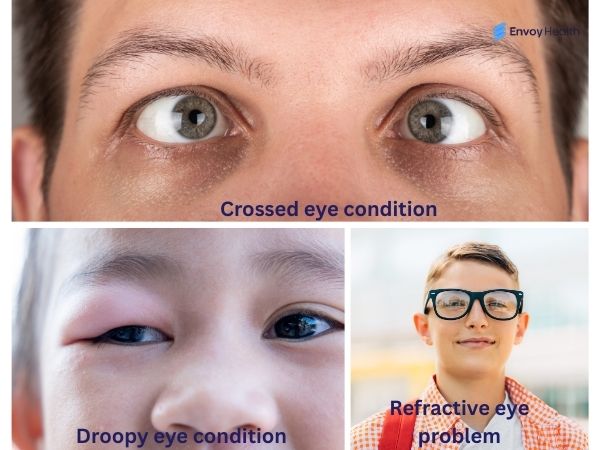
- Lazy eye is an issue with the brain's connections for processing visual information and depends largely on a single eye. It generally occurs due to crossed eyes, where the two eyes fail to track in the same direction. Droopy eyelids and significant refractive issues can also lead to lazy eye.
- Non-surgical approaches are an initial treatment strategy. Covering the dominant eye with an eye patch to blur it and performing vision therapy trains the brain to use the weaker eye. Eye surgery for lazy eye actually corrects the underlying eye-related problems that force the brain to rely on one eye.
- Lazy eye surgery corrects underlying conditions such as strabismus, droopy eyelids, or significant refractive errors that cause the brain to rely on visual input from one eye instead of both.
Still comparing Eye Surgery options?
Envoy can help you compare reviewed clinics, pricing guidance, and recovery expectations before you make a decision.
Crossed Eye Versus Lazy Eye: What To Know?
A typical human brain processes images captured by two eyes into a single 3D image, a process we call depth perception. In some individuals, both eyes aren’t aligned in the same direction, so both eyes don’t look at the same spot. One drifts either upward, downward, inward, or outward, causing a condition called crossed eyes (squint eyes, wandering eye, or strabismus).[1] This misalignment doesn’t simply end with an awkward appearance.
Over time, the brain tends to favor processing visual information from one eye while ignoring the other. It causes poor vision, with a significant difference in refractive errors between both eyes. Individuals experience problems such as headaches, tired eyes, and inappropriate depth perception. Gradually, one eye (usually the weaker one) wanders inward or outward, often failing to track objects, which can lead to lazy eye (ambylopia). So, while strabismus is a crossed-eye condition (mainly an alignment issue), ambylopia is a problem with the brain's processing of visual information (clearly a vision issue). Moreover, strabismus isn’t the only cause for ambylopia, aka lazy eye. Major refractive errors, such as near- or farsightedness, astigmatism, or obstruction (something blocking the eye, such as droopy eyelids or a cloudy cataract lens), also cause the lazy eye problem.
Can Lazy Eye Be Corrected With Surgery?
Yes, lazy eye can be corrected with surgical intervention. But the type of procedure largely depends on the candidate's eye health, underlying cause, age, and severity of the issue. Ambylopia, or lazy eye, requires early intervention, as delaying treatment can lead to permanent vision loss. Early treatment encourages the brain to use the weaker eye rather than relying on a single eye for complete vision. Typically, humans develop critical vision from birth to around age 7-8. The brain in candidates with severe lazy eye relies on one eye's vision and fails to process the other eye's. Early detection and treatment help train the brain to form connections with the weaker eye and restore normal vision. Ophthalmologists may recommend vision therapy, eye patches, corrective eyewear, or surgical treatment to treat the lazy eye condition.
- Eye patch treatment for lazy eye: Ophthalmologists often recommend this method for children with lazy eye. They cover the stronger eye with a patch for several hours a day, so the child sees through the weaker eye. This forces the brain to develop neuronal connections to use the weaker eye.
- Corrective eyewear: Glasses or contact lenses are used to address the underlying vision issues and improve ambylopia. The goal of this approach is to force the brain to form new neuronal connections and to use the weaker eye.
- Eye drops: Ophthalmologists use blurring eyedrops to blur the vision in the stronger eye. So that the brain relies more on the weaker eye when the dominant eye's vision is temporarily compromised.
- Vision therapy: It addresses the root cause and aims to improve the weaker eye’s use. It relies on structured activities to improve focus, tracking, and its coordination with the dominant eye. You may consider it physical therapy for the eyes, teaching them to work together.
- Eye surgery to fix lazy eye: It corrects the underlying causes leading to the lazy eye condition. For many people, wondering can surgery fix a lazy eye, the answer isn’t straightforward. And that’s because the term lazy eye is often misunderstood. Ophthalmologists use surgery to correct underlying eye problems such as crossed eyes (strabismus), droopy eyelids, or significant refractive errors. These conditions affect how the eyes are positioned or function physically. However, this is not the same as amblyopia, which is what doctors medically refer to as a lazy eye. Amblyopia occurs when the brain favors one eye over the other. What people commonly call “lazy eye surgery” actually refers to procedures that correct the underlying eye condition that may be contributing to the problem.[2] Treatment varies based on factors such as age, overall eye health, and the severity of the condition. That’s why consulting an ophthalmologist is essential before deciding on any treatment approach.

What Is Eye Surgery for Lazy Eye Called?
What’s commonly referred to as eye surgery for lazy eye is usually known as strabismus surgery. This procedure adjusts the eye muscles to improve alignment when crossed eyes are present. In some cases, ophthalmologists may also recommend surgery to correct droopy eyelids or address other structural issues that affect vision.
The type of eye surgery for lazy eye depends entirely on the underlying cause and the patient’s individual needs. A thorough eye examination helps determine whether surgery is appropriate and which approach offers the best outcome.
- Eye surgery for lazy eye due to strabismus: This method realigns the eye's muscles, improving appearance and depth perception. The method varies depending on the underlying eye muscle problem. Typically, resection is performed to shorten the muscle and keep the eyeball in place. On the other hand, a few require plication, to shorten the muscle by folding it over. Some require a recession to move the muscle back, loosen it, and hold the eyeball in place. Whatever the approach, the goal is to adjust the eye muscle attachments and reposition them for better coordination.
- Eye surgery for lazy eye due to droopy eyelids: Lazy eye due to droopy eyelids or ptosis is more common in adults than in children. Ptosis repair surgery to fix lazy eye in adults is typically followed by blepharoplasty. The eyelid muscles are tightened or reattached for a better lift. While many confuse ptosis repair as a cosmetic eye surgery for lazy eye, it actually enhances vision by clearing the pupil. It's worth noting that blepharoplasty is primarily a cosmetic procedure rather than ptosis repair.
- Corrective eye surgery for lazy eye: The procedure does not directly cure ambylopia (lazy eye). Instead, they correct the causative refractive errors, such as severe near- or farsightedness. A clearer vision for an ambylopic eye enhances eyesight, helping with vision therapy and patchwork. Note that the refractive error correction should be combined with appropriate vision training. A lack of brain training to process visual input from both eyes cannot fix the neuronal pathways, leading only to inappropriate results.
How Much Is Eye Surgery for Lazy Eye?
Eye surgery for lazy eye costs between $3,500 and $10,000 per eye in the United States. Typically, this cost covers hospital and surgeon fees, anesthesia charges, facility fees, and medications. Generally speaking, the eye surgery for lazy eye price takes a broader range. And it's worth noting that it varies considerably with the surgeon’s expertise, the severity of the eye condition, the type of eye surgery (strabismus, droopy eyelid, or refractive), and the clinic's location.
Who Will Need Eye Surgery for Lazy Eye?
Generally, candidates with severe alignment (due to crossed eyes) and depth perception issues require eye surgery for lazy eye. Surgery is often considered a secondary treatment, but initially, traditional approaches are considered a better option. These include eye patch treatment, glasses, or blurry eye drops. It's important to note that early diagnosis and intervention have better results. Brain connections typically develop during early childhood. Treatment started at a younger age yields better results. When these approaches fail to achieve functional vision or correct alignment, eye doctors may recommend surgical intervention.
When Should You Consider Surgery To Treat Lazy Eye?
You may consider eye surgery for wandering eye in any of the following conditions:
- You suffer from persistent misalignment of the eye despite wearing an eye patch or prescription glasses.
- You have a significant physical obstruction (such as droopy eyelids or a cataract) that is blocking vision.
- You experience worsening of misalignment despite trying the non-surgical intervention.
- Your crossed-eye condition is severe, and you face difficulty with depth perception that interferes with routine life activities.
Besides the eye condition, age is another significant criterion for those considering surgery. The results may be compromised in older children, teenagers, and adults, for whom non-surgical treatments are less effective because visual development has already been completed. Generally, eye surgery for lazy eye kids offers better results than in late teens.
What To Expect Before, During, and After Surgical Procedures To Fix the Lazy Eye Condition?
Treating a lazy eye takes longer, beginning with non-surgical interventions and brain training. We detailed a pre-surgical evaluation, what happens during the procedure, and the recovery process afterward to better understand.
Pre-Surgical Evaluation
Before the surgical procedure, you will attend a detailed eye examination. Your ophthalmologist will evaluate your eye health and check for the underlying cause of ambylopia. They will assess the degree of misalignment and perform muscle function tests to determine whether the ocular muscles are weak or overactive. They will also learn about your overall medical history, along with your previous and ongoing medications. Don’t ignore sharing the appropriate details about current or prior use of blood thinners, allergies, and anesthesia. You should stop using certain medications, such as aspirin and other blood thinners, a few days before surgery (according to the ophthalmologists' recommendations). Plus, you should stop wearing contact lenses as your eye doctor recommended.
Surgical Treatment
You will be asked to fast strictly the night before eye surgery for lazy eye. The procedure will be carried out under general anesthesia. Some adults may also require numbing eye drops or sedation in case of anxiety. This will provide a sense of relaxation during the surgical procedure. You will receive IV medication, and your vital signs will be monitored throughout the procedure. The procedure varies with the surgical method and underlying cause.
Strabismus surgery involves altering the muscle that controls the eye. It involves either resection or cutting and reattaching the muscles that hold it. Surgery to fix droopy eyelids involves tightening the levator muscles that hold the eyelid. The surgeon will either reattach the eyelid muscles to the brow muscles or cut them to shorten appropriately. On the other hand, refractive eye surgeries to correct vision issues are performed based on the underlying problem. These rely on simpler, more precise lasers to create corneal flaps and reshape the cornea to correct the vision issue.
Recovery
After the surgical procedure, you will be shifted to the recovery room, where your vitals will be monitored. You will initially rest for a few hours and then return home. Have an elderly friend or family member pick up your post-procedural medication and drive you home.
At home, rest for a few days, and take off from school, college, or work as you recover. Expect slight swelling and bruising during the first few days of eye surgery for lazy eye recovery. Use the prescribed anti-inflammatory pain medications and antibiotics during the first few days. Follow the aftercare instructions, and protect your eyes from external dust and allergens by wearing protective eyewear.
Is Lazy Eye Surgery Dangerous?
According to the American Academy of Ophthalmology, lazy eye surgery is safe and has a decent success rate.[3] Major complications, such as infection and scarring, are typically rare. However, temporary side effects such as redness, soreness, and light sensitivity may occur. These resolve gradually as you recover. Candidates with a severe crossed eye condition may require a second surgery, as the initial surgery may not fully correct the alignment issue.
When Should You See an Ophthalmologist After Eye Surgery for Lazy Eye?
Your ophthalmologist will schedule follow-up appointments after eye surgery for lazy eye. You should not ignore them, as the eye doctors will:
- Monitor the healing progression: They will check for visual signs of infection and inflammation. This is crucial to prevent complications early on.
- Adjust the treatment: Any surgery for lazy eye requires adjusting brain training, such as patch treatment and visual exercises, for optimal results.
Attending scheduled follow-up appointments will not only prevent complications but also improve outcomes. It also ensures adequate healing progression, with proper alignment and brain training to use the weaker eye.
While we emphasize scheduled follow-up sessions, don’t hesitate to see your ophthalmologist when you notice unexpected complications. Prolonged redness, inflammation, infection, abscess, or cyst (accompanied by pus or fluid build-up), and vision loss with black curtains are signs of serious complications. See your ophthalmologist or a nearby healthcare provider for prompt care. Remember, acting early can prevent inadequate consequences.
Final Word!
Eye surgery for lazy eye is not a one-size-fits-all solution, but it can be an effective option when underlying eye alignment or structural issues interfere with vision. While treatment often begins with non-surgical approaches, surgery may play a crucial role for patients who do not respond to conservative methods. Understanding the benefits, limitations, and expected outcomes helps set realistic expectations. Consulting an experienced ophthalmologist ensures the treatment plan is tailored to the individual’s age, eye health, and condition severity, leading to better long-term visual results.
Thinking about eye surgery for lazy eye? Envoy Health connects you with carefully vetted ophthalmology specialists and guides you through every step. Sign up now, and our care team will reach out to you and guide you every step of the way. So you don’t have to worry about arrangements and can make confident, informed treatment decisions.
References
Ready to compare Eye Surgery options?
Get clinic options, pricing guidance, and recovery expectations from Envoy Health before taking the next step.
Disclaimer
The information in this article is for educational purposes only and does not replace medical advice. Always consult your doctor before starting any treatments.
Published by Envoy Health. Reviewed for patient-safety framing by Envoy Health Medical Content Review. See our editorial, AI-assistance, and medical review policy.
To request a correction, email contact@envoyhealth.io with the page URL and supporting source.
Compare reviewed clinics, pricing guidance, and recovery expectations before you commit.
Lazy eye surgery is covered by insurance when performed for functional reasons. These include correcting double vision and eye strain, rather than meeting cosmetic goals.
LASIK eye surgery does not treat lazy eye. LASIK, also called laser in-situ keratomileusis, actually corrects the vision problems such as near- or far-sightedness. However, lazy eye, or ambylopia, involves the underlying neural connections and differs slightly from other vision issues.
Correcting lazy eye costs anywhere between $1,500 and $10,000. It depends on the severity of the issue and the chosen treatment, whether surgical or non-surgical. While strabismus surgery costs between $5,000 and $10,000, non-surgical approaches, such as patch treatment and vision therapy, cost less at around $500-$1,500.
The surgery to correct lazy eye (strabismus surgery) is typically painless. You don’t feel much pain as it is carried out under general anesthesia. However, you will feel redness, inflammation, and swelling after the procedure.
So, we partner with the premier healthcare facilities!
Send me the list